xxx
“You’d never manage that these days – they could probably tell you what type of dog was doing the running for you.”
xxx
A library of snippets
xxx
“You’d never manage that these days – they could probably tell you what type of dog was doing the running for you.”
xxx
xxx
In the United States currently, there’s no legal requirement stipulating a financial institution must make a consumer’s financial data available to a third party in the event that a consumer provides affirmative consent.
From U.S. way behind the curve on open banking | American Banker.
xxx
xxx
While the Treasury Department cannot address the intrinsic, structural disadvantages in the U.S. regulatory regime, its recent call for all of the agencies in this space to align behind an interpretation of Section 1033 of the Dodd-Frank Act — which asserts the ability of Americans to permission their financial data — is an important step towards a level playing field,
From U.S. way behind the curve on open banking | American Banker.
xxx
xxx
In a UK first, customers who receive a call from Barclays will now be able to choose to receive an alert in their app or online banking confirming the details of the employee who is calling them.
From Barclays tackles phone scammers with caller ID feature.
So good to see a bank doing this. I wrote
Remember when, earlier this year, the main US carriers Verizon Wireless, AT&T, T-Mobile and Sprint (as the “Mobile Authentication Taskforce”) announced their plan to launch a mobile authentication solution that will be available to consumers by the end of 2018. The idea of it is to securely authenticate users by using their mobile number, IP address, SIM card attributes and so on, using machine learning and so forth to reduce the risks in mobile commerce.
(They said at the time that the service would be interoperable with the GSMA’s Mobile Connect scheme, which is great).
Well, they’ve now announced their “Project Verify” which will deliver authentication in mobile apps, negating the need for a traditional password. You can see the attraction for users: it means major convenience.
xxx
n 1303, a Persian vizier recounted the use of fingerprints as signatures during the Qin and Han Dynasties, noting, “Experience has shown that no two individuals have fingers precisely alike.” The Chinese had realized that before anyone: a Qin dynasty document from the third-century B.C.E, titled “The Volume of Crime Scene Investigation—Burglary,” pointed up fingerprints as a means of evincing whodunnit.
xxx
xxx
Among Amazon Prime respondents, 65% would be willing to try a free online bank account offered by Amazon. Even among people who don’t buy through Amazon, 37% would be willing to try. Amazon customers are quite valuable. They control 75% of US household wealth
From Can Amazon Take Customer Loyalty to the Bank? – Bain & Company.
xxx
Alex Brazier is the Executive Director for Financial Stability Strategy and Risk and a member of the Financial Policy Committee (FPC) at the Bank of England. He’s not a techno-utopian fintech hype merchant like me, he’s an economist. Earlier this year, he gave a speech talking about open banking in which he said that “by allowing customers to connect to a range of banks and service providers through a single point, Open Banking could open to the door to the ‘unbundling’ of banking”.
At Consult Hyperion we don’t think there’s any “could” about it but, as my colleague Tim Richards wrote earlier this year, some banks will thrive in the world of open banking while will simply become utilities, highly regulated pools of capital. He goes on to say that while both models are acceptable – which is why some of the work we are doing helping clients to determine their open banking strategies is so interesting – as a bank surely it would be better to choose your strategy rather than being forced into a model you may not be well suited for.
For a consumer perspective, it could be argued that the unbundling is a good thing. Bringing together bundles of services from different providers is actually quite an appealing vision of the banking front-end of the future. The problem, from the banks’ perspective, is that that the front-end neither needs to be a bank nor wants to be a bank. Quite the reverse, in fact. The people who are good at front-ends (eg, Amazon) are perfectly happy to take control of the interface with the consumer and, as per Tim’s point, leave the banks as heavily regulated, low margin pipes sitting out of sight as the equivalent of utility companies but for money rather than gas, water or electricity.
How can banks compete with this? Well, they can become technology companies. Now, I know that the “meme” that banks are, essentially, a special kind of technology company (special because they are granted special privileges that other companies do not have, such as the ability to create money) is not mainstream, it deserves attention. It means, apart from anything else, that bank boards will need to include switched-on technologists and take a strategic view of technology, as Christian Edelmann and Patrick Hunt said in the Harvard Business Review: “Technology specialists will play a greater role in allocating investments, working alongside senior management from a more traditional background”.
 //embedr.flickr.com/assets/client-code.js
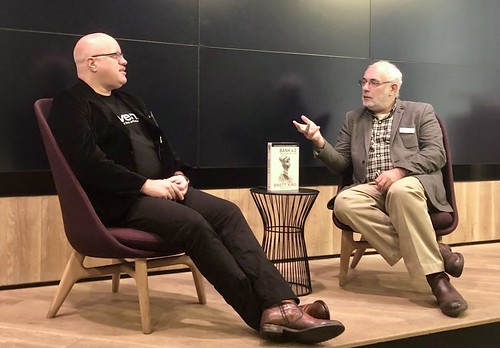
This is a point that was well made by my old friend Brett King when I had my “fireside chat” with him at the Consult Hyperion Unconference in Manhattan last month. We talked about his new book “Bank 4.0”, in which he says that the foundation of banking in the coming era is “being great at technology” and one or two other things. If you’d like to learn more, you can listen to Brett and I discussing the book in the latest Tomorrow’s Transactions podcast available here on our web site or via our iTunes feed.
In the book Brett quotes Francisco Gonzalez, the Executive Chairman of BBVA, as saying that sooner or later it will be the internet giants (including Amazon) who will be his main rivals rather than other banks. This is why BBVA is reinventing its processes to being new products and services to the markets. But can banks really become technology companies? Many observers think not. Instead they posit a future for banks as financial factories who have to accept the new order and partner with Amazon and others. Lenders would manufacture financial products, and tech giants would serve as distribution and servicing channels. In other words, Amazon’s future is to do with financial products what Amazon already does with other products.
What’s more, as that Bloomberg article notes, because Amazon wouldn’t have to pay to lure customers — it already has millions of them — it could afford to set up digital accounts without “all the nuisance fees and relatively high minimum balances” that lenders impose. The Wall Street Journal says similarly that banks “face pressure to build relationships with big online platforms, which reach billions of users and drive a growing share of commerce” when reporting on Facebook’s request to banks to share detailed financial information about their customers, including transactions and balances, “as part of an effort to offer new services to users”.
As Tim and I have mentioned before, in Europe the banks won’t have any choice about this. The CMA Remedies in the UK (since January) and PSD2 implementation throughout Europe from next year means that it will be the consumers who will have the choice whether to give the internet giants access to their accounts, not the banks’. This is why it is so important for banks, payment companies and others in the space to develop business strategies for the open banking world – now.
xxx
The feature allows new iPhones to conduct supported NFC transactions without the assistance of iOS.
The specs for the iPhone XS list “Express Cards with power reserve” under all models.
From New iPhones can conduct certain NFC transactions even when iOS is not running.
xxx
xxx
“September 13, 1968, the German engineers Juergen Dethloff (1924-2002) and Helmut Groettrup (1916-1981) filed a patent in Austria for their idea of an ‘identification circuit’.”
From “First Chip Card Patent Filed 50 Years Ago on September 13, 1968”.
xxx
For the first decade or so, it was far from clear whether the credit card was continue to exist as a product at all, and as late as 1970 there were people predicting that banks would abandon the concept completely. What changed everything was technology: the introduction of the magnetic stripe and Visa’s BASE I online authorisation system. This changed the customer experience, transformed the risk management and cut costs dramatically. Everything changed with automated authorisation.
I can’t resist pointing out that it was the London transit system that pioneered the use of magnetic stripes on the back of cardboard cards in a mass market product (seven years earlier, in 1964). The first transaction was at Stamford Brook station on 5th January 1964, well before BankAmericard (the precursor to Visa) introduced their first bank-issued magnetic stripe card in 1972 in conjunction with the deployment of the BASE I electronic authorisation system in 1973.
As I wrote back in 2008, setting out “I have seen the future, and it is the London mass transit system” theory of payments, we should look at what they were doing to see what banks would be doing in a couple of years time and what they were doing, of course, was contactless, which now accounts for X in Y card payments in the UK. I was reminded of this b
xxx
It’s no exaggeration to say that TfL’s technology has transformed the payments industry, and contactless is quickly becoming ubiquitous
From Digital Currencies And Credit Cards Have Subways To Thank For Their Existence.
xxx
Now I read that Hong Kong MTR, where it all kicked off the with contactless Octopus card, is going to tender for a QR code solution.

 Snippings