POST Digital Identity, not Digitised Identity

The US Treasury’s report on “Nonbank Financials, Fintech, and Innovation” prepared in response to Mr. Trump’s “Executive Order 13772 on Core Principles for Regulating the United States Financial System” is, I have to say, most comprehensive. It covers a great many aspects of the financial services market, as you would imagine, and covers a few specific areas that I think are worth detailed consideration and due some real innovation. One of them is digital identity.

The Treasury report says that digital identity systems may rely on various types of technology but generally involve two essential components: (1) identity proofing, enrollment, and credentialing; and (2) authentication. It then goes on to say that they may also involve (3) federation, which is optional, but allows identity to be portable.
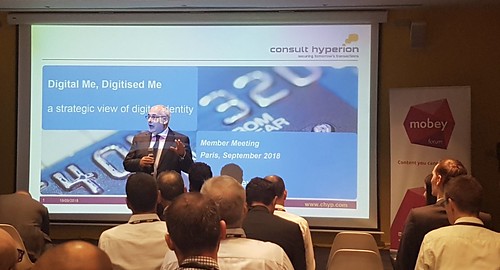
Presenting at Moby Forum Members Meeting//embedr.flickr.com/assets/client-code.js

Indeed. This is a reasonable way to think about the problem. I presented this view at the MobeyForum Members’ Meeting in Paris, showing how these three components are used in our “three domain identity” or “3DID” model for digital identity that I have written about before. Here’s the model, along with the US National Institute of Standards and Technology (NIST) draft standards, in a picture from that presentation.
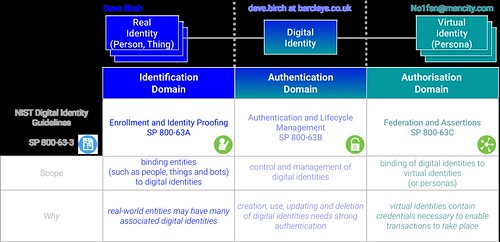
3DID with NIST Revised

Of course I don’t regard the federation as optional because I’m not really interested in identity solutions that work only for the issuer. What I think the mass market wants is identities that individuals can choose to use in as many or as few places as they like. A Barclays identity that I can only use to log in to Barclays is one thing, whereas a Barclays identity that I can use to log in to all sorts of places in much more desirable. Michael Salmony made this point quite well in his presentation to MobeyForum event, making the point (similar to mine) that existing digital identity efforts were not really producing the results that we want. 
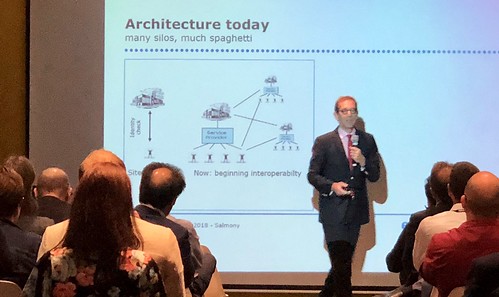
Mobey Paris//embedr.flickr.com/assets/client-code.js

One point that Michael made 
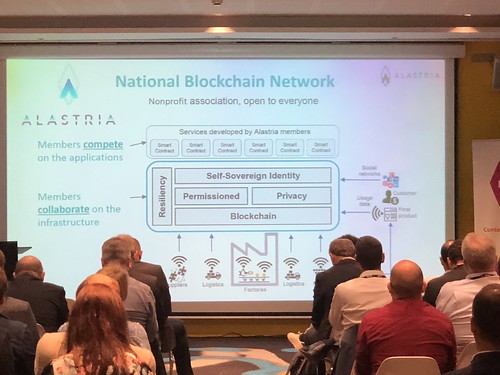
Mobey Paris//embedr.flickr.com/assets/client-code.js

Xxx

Bitcoin Accepted [Everyw]here: Square Patents Crypto Payment Network

xxx

The payment service will accomplish this by maintaining a private blockchain that records transactions from Square-managed wallets in real-time

From Bitcoin Accepted [Everyw]here: Square Patents Crypto Payment Network.

So, basically, if you send cryptocurrency from a Square cryptocurrency wallet to another Square cryptocurrency wallet, Square will credit the recipient in near-real time and take the risk that you don’t then go and send the same cryptocurrency to someone else.

(Note: To operate such a system, you don’t need wallets or blockchains. You could just use a database and call it Square-PESA.)

POST The US is Different

The US Treasury’s report on “Nonbank Financials, Fintech, and Innovation” prepared in response to Mr. Trump’s “Executive Order 13772 on Core Principles for Regulating the United States Financial System” is, I have to say, most comprehensive.

Payments Treasury recommends that the states work to harmonize money transmitter requirements for licensing and supervisory examinations, and urges the Bureau to provide more flexibility regarding the issuance of remittance disclosures. Treasury encourages the Federal Reserve to move quickly in facilitating a faster retail payments system, such as through the development of a real-time settlement service that would allow for more efficient and widespread access to innovative payment capabilities. Such a system should take into account the ability of smaller financial institutions, such as community banks and credit unions, to access innovative technologies and payment services.

The Ends of the Month: The Elephant in the Room – CFSI – Medium

xxx

“overdraft and returned-check fees (NSF) [were] $15 billion in 2015… nearly twice what the entire payday lending industry earned in interest and fees in 2015. It also approached the $18.4 billion earned by the entire US banking system on merchant interchange from all debit card and general-use prepaid cards in that year. And it was considerably greater than what banks earned on all other deposit account fees combined.”

From “The Ends of the Month: The Elephant in the Room – CFSI – Medium”.

xxx

‘I went on holiday – so how was my card used for a £600 spree at home?’ | Money | The Guardian

xxx

Banks maintain that contactless is safe, and card cloning is not cost-effective for thieves.

From ‘I went on holiday – so how was my card used for a £600 spree at home?’ | Money | The Guardian.

Not cost effective in the sense that it is not possible. If thieves do find a way to extract the private keys from the tamper-resistant chip on a contactless card, they the entire payment card system will collapse overnight. Don’t panic about it: they haven’t, and they are extremely unlikely to.


In 2015 consumer group Which? used cheaply bought card readers, and freely available software, to remotely “steal” key details from a contactless card and use them to buy items online, one of which was a £3,000 TV.

From ‘I went on holiday – so how was my card used for a £600 spree at home?’ | Money | The Guardian.


Ah. I see what you’ve done there. You’ve taken the card number and expiry dates, which are in any case printed on the front of the card (and even embossed to that you can steal them quickly but rubbing a pencil over a piece of paper) and used them to buy goods and an online merchant that doesn’t not do either an AVS or CV2 check. The rules about this are clear: the liability is the merchant’s and neither the issuing bank nor the customers should care less. If merchants are happy to accept this risk, then so what.

However, the point is: the cards are not being cloned.

Opposing change? The price impact of removing the penny | Bank Underground

xxx

Would removing the 1p and 2p coins from circulation cause inflation? Or deflation? Or neither? Our analysis, and the overwhelming weight of literature and experience, suggests it would have no significant impact on prices because price rounding would be applied at the total bill level, not on individual items and it would only affect cash transactions, which make up a low proportion of spending by value.

From Opposing change? The price impact of removing the penny | Bank Underground.

xxx

What would you toss? | Consult Hyperion

xxx

In some European countries — Finland and the Netherlands are good examples — both retailers and consumers have spontaneously abandoned low-value coins. Transactions are automatically-rounded (by custom and practice, not by law) to the nearest five euro cents and the one- and two-cent coins are just thrown away.

From What would you toss? | Consult Hyperion.

xxx

Design a site like this with WordPress.com
Get started