Facebook can do it, why can’t Barclays

I notice that Facebook has been hacked. Apparently, some 30 million people had their phone numbers and personal details exposed in a “major cyber attack” on the social network in September. Around half of them had their usernames, gender, language, relationship status, religion, hometown, city, birthday, device types used to access Facebook, education, work, the last 10 places they checked into or were tagged in, website, people or Pages they follow, and the 15 most recent searches all compromised. Wow.

Now, I don’t really care about this much personally. Like all normal people I have Facebook and enjoy using it to connect with family and close friends, but I don’t use my “real” name for it and I never ever gave in to their pleading for my phone number. Not because I was unsure that it would at some point get hacked (I assumed this to be the case) or because I thought that if I used it for two-factor authentication they might use it for advertising purposes, but on the general data minimisation principle that’s it’s none of their business.

(We should, as a rule, never provide data to anyone even if we trust them unless it is strictly necessary to enable a specific transaction to take place.)

One of the reasons that I don’t care is that just as people around the globe are getting spammed by fraudsters pretending to be Facebook, I’m not worried about spammers getting my data and pretending to be Facebook. When I get e-mail from Facebook, it is encrypted and signed using a public key linked to the e-mail address I use for this purpose (pseudonymous access). See…

xxx
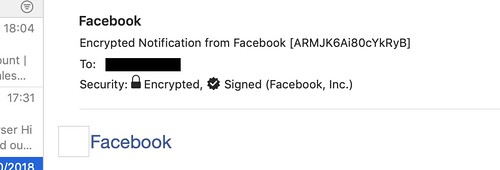
Facebook Mail


My e-mail client (in this case, Apple Mail) will flag up if the signature is invalid. If you want to send encrypted e-mail to me at mail@dgwbirch.com then you can get my PGP key from a public key server (check the fingerprint is 50EF 7B0E FD4B 3475 D456 4D7E 7268 01F2 A1C5 075B if you want to) and then fire away. It’s not that difficult. Facebook asked me if I wanted secure e-mail, I said yes, they asked me for my key, I gave it to them. End of. I really don’t understand why other organisations cannot do the same.

Banks, for example.

Here’s an e-mail that I got purporting to be from Barclays. They are asking me for feedback on their mortgage service and inviting me to click on a link. I suppose some people might fall for this sort of spamming but not me. I deleted it right away.
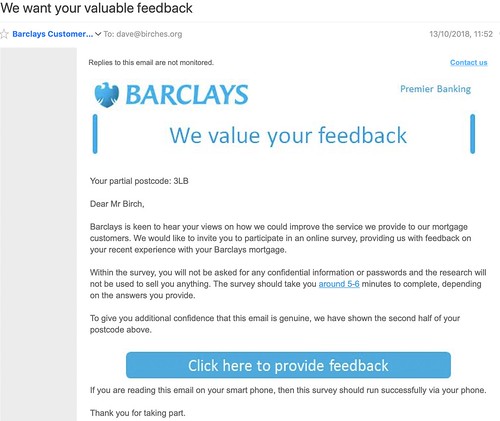
Barclays Mail

This of course might lead reasonable people to ask why Barclays can’t do the same as Facebook. Why can’t Barclays send e-mail that is encrypted so that crooks can’t read it and signed so that I know it came from the bank and not from spammers. Surely it’s just a couple of lines of COBOL somewhere ask me to upload my public key to their DB2 and then turn on encryption. Right? After all, it’s unencrypted and unsigned e-mail that is at the root of a great many frauds so why not give customers the option of providing an S/MIME or PGP key and then using it to protect them?

Or, better still, why don’t Barclays STOP USING EMAIL AND TEXTS since they have an APP ON MY iPHONE that I use ALL THE TIME and they could send me SECURE MESSAGES using that. It’s time to move to conversational commerce based on messaging and forgot about the bad old days of insecure, spam-filled, fraudophilic and passé e-mail.
Auditors face probe over Patisserie Valerie crisis following discovery of £28.8m black hole | Daily Mail Online

xxx

Work by Grant Thornton has been called into question after bosses at Patisserie discovered a £28.8million black hole in the accounts, an unpaid tax bill and two ‘secret’ overdrafts totalling nearly £10million.

The auditor has worked for the company since 2006 and most recently signed off the books for the year to September 30, which said the balance sheet was strong and contained no borrowing.

From Auditors face probe over Patisserie Valerie crisis following discovery of £28.8m black hole | Daily Mail Online.

xxx

Commercial concerns push two IDPs away from Verify as it heads towards private sector delivery – Government Computing Network

xxx

I don’t think there are many people left in government who understand digital identity.”

From Commercial concerns push two IDPs away from Verify as it heads towards private sector delivery – Government Computing Network.

To be honest, there weren’t that many to begin with.

Facebook warns 30m users exposed in cyber attack – how to check if you were affected

xxx

“Of these, 15m had their names, phone numbers and email addresses accessed. An additional 14m also had usernames, gender, language, relationship status, religion, hometown, city, birthday, device types used to access Facebook, education, work, the last 10 places they checked into or were tagged in, website, people or Pages they follow, and the 15 most recent searches.”

From “Facebook warns 30m users exposed in cyber attack – how to check if you were affected”.

xxx

The untold story of Stripe, the secretive $20bn startup driving Apple, Amazon and Facebook | WIRED UK

xxx

“When Berners-Lee and his team were building the world wide web and designing HTTP and HTMP standards, they included error codes such as ‘500: internal server error’, or ‘404: page not found’. In the early 90s, they were trying to realise Licklider’s vision and setting out the rules for how we were all going to interact over this information network. One long-standing error code is ‘402: payment required’. The original intention – the reason 402 is reserved for future use – was that this code would be used to transact digital cash or micropayments. It has never been implemented – and the Collisons argue this is the reason tech is turning from an equal access opportunity to an oligopoly controlled by five companies now worth more than $3 trillion.”

From “The untold story of Stripe, the secretive $20bn startup driving Apple, Amazon and Facebook | WIRED UK”.

xxx

MEDIUM A cashless New Year

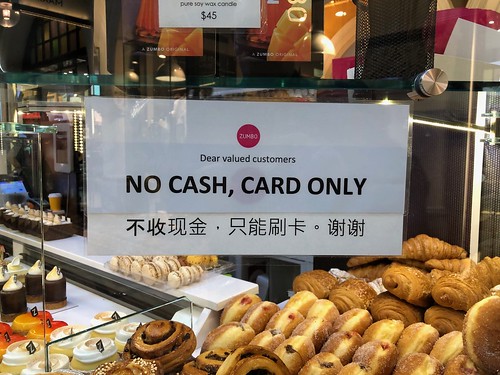
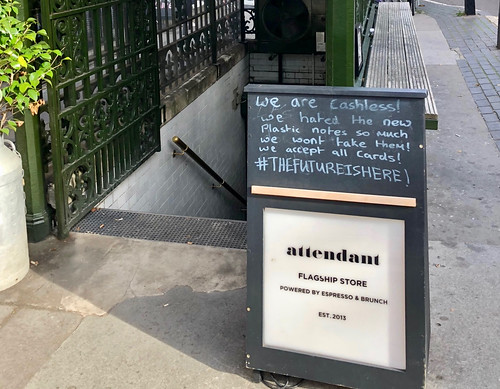
I was very happy to note that Starbucks has decided to go the extra step and get rid of cash. Well, in one of its stores at least. The coffee chain is conducting an experiment at a branch in Seattle, Washington, by having it go completely cash free to explore the the dynamic. It hasn’t yet spread – the last Starbucks I was in I wanted to pay using my app but I’ve forgotten the password so I just used a contactless card (like pretty much everyone else in the line), but I’m sure I saw someone pay with cash while I was waiting – but I’m sure it will as the meme is speaking. Credo tested a cash-free policy at its San Francisco and Brooklyn stores and “it went off without a hitch” so the chain opened its first cash-free establishment in Boston and never looked back.

No Cash, Card Only

//embedr.flickr.com/assets/client-code.js

Cafés are following suit in other developed nations. A new one in Singapore had the proud title of the first cashless restaurant on the Island. Interestingly, as well as taking the usual payment cards (including NETS, the local debit network), they used the opportunity to accept cryptocurrencies “such as Bitcoin” (although I’d be surprised if anyone paid this way.). Why the trend? Well, as the Washington restaurateur Bo Blair (whose company operates eight fast-casual and three sit-down restaurants in DC, some of which had been robbed) notes, while cost-conscious small businesses might operate cash-only to avoid card processing fees, cash has hidden costs such as armoured cars taking money to banks, an extra hour for workers to cash up (and dishonest employees helping themselves).

No Cash//embedr.flickr.com/assets/client-code.js 

Now, coffee shops and cafes go cashless for all of these reasons – the cash register wastes counter real-estate, making change is time-consuming and holds up the line, cashing up is an unproductive use of resources – they have an extra driver. Here’s what an Australian butcher had to say about it: “We’ve been cashless for 3 years now and haven’t looked back… We made the switch for a number of reasons, but chief among them was something that’s of the utmost importance when selling food: hygiene”. I can remember this being a factor many, many years ago in the early trials of Mondex. For bakers (and hairdressers, as I remember) handling dirty money meant that they had to keep moving away from customers to go and wash their hands.

Anyway, hand washing or not, contactless has exploded in the UK. In the last year, contactless payments volumes were up by around a third and contactless is now more popular than chip and PIN at POS. In fact, contactless is now more popular than cash (cash usage fell 15% last year).

Contactless makes all of the hidden costs of cash a thing of the past. Frankly, it’s not that hard for food outlets in certain places (eg, London) to decide to go down this route. In the UK, over a third of people surveyed regularly leave home and go out with just one or more cards, while a sixth already leave home with just a single contactless payment method (which in some cases will be phone or a wearable I think). This why I told the BBC, in a story about cashless pubs, that “It’s slightly surprising to me that there aren’t more of these cashless places already”.

ECB has no plan to issue digital currency – Draghi | Reuters

xxx

“The European Central bank has no plan to issue a digital currency because the underlying technology is still fragile and the use of physical cash still high in the euro zone, the ECB president said on Friday.”

From “ECB has no plan to issue digital currency – Draghi | Reuters”.

According to Reuters, the President of the European Central Bank (ECB) Mario Draghi has reiterated that there are 

Nigerians bury cash in backyards as mobile banking stumbles

Meanwhile, in Nigeria

“Every few days, Tasiu Abdurrahman takes the money he makes from selling spices and buries it in his yard. The 55-year-old closed his bank account eight years ago after growing disillusioned with standing in long lines for hours to deposit or withdraw cash.”

From “Nigerians bury cash in backyards as mobile banking stumbles”.

xxx

xxx

“Less than 6% of Nigerians use their handsets to transact using mobile money, compared with 73% of Kenyans, where more than two-thirds of adults have a bank account”

From “Nigerians bury cash in backyards as mobile banking stumbles”.


xxx

xxx

“Cellular phone operators would invest more if they were allowed to lead the way, said Emeka Oparah, a spokesman for Bharti Airtel Ltd.’s Nigerian unit, which has 40 million subscribers.”

From “Nigerians bury cash in backyards as mobile banking stumbles”.


xxx

Design a site like this with WordPress.com
Get started