Cashless: CBN to revoke 15 mobile money licences

Nigeria is a fascinating business school case study of the relationship between regulation and technology in payments. It ought to be a mobile payments powerhouse, but the regulatory strategy there has resulted in a plethora of subscale mobile money businesses.

Despite having 21 mobile money operators licensed by the CBN in the circulation, the volume of transaction on the payment platforms is still grossly low

From Cashless: CBN to revoke 15 mobile money licences

xxx

Getting down down under

Well, this week we saw another milestone in the evolution of the global payments marketplace.

The New Payments Platform (NPP) will enable customers of Commonwealth Bank, National Australia Bank and Westpac to send money via a service called PayID, which requires users to enter only the recipients’ mobile phone number or email address. Other financial institutions, including ANZ, will follow.

From Aussie real-time payments platform goes live

xxx
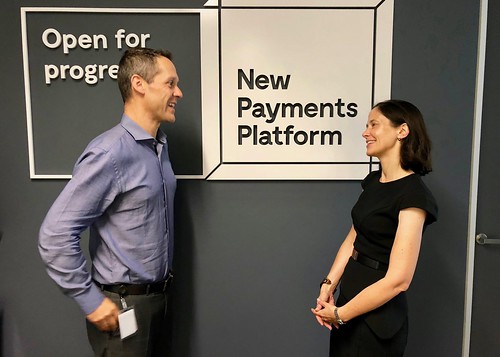
NPPA on launch day.//embedr.flickr.com/assets/client-code.js

To celebrate this event, I went to Australia to record a podcast with NPP Australia Ltd, who developed the system with 13 financial institutions. Adrian Lovney is CEO of NPP Australia and Katrina Stuart is the Executive Manager for Engagement. In the podcast, they explain the key features of NPP and chat about the new products and services that it could enable.

From a UK perspective, I’d highlight three areas where NPP is different to our existing Faster Payment Service (FPS) and may inform debate about our New Payments Architecture (NPA). These are settlement, data and

First, settlement. NPP is a real-time gross settlement system (RTGS), unlike FPS which is a net settlement system.

Second, data. NPP uses ISO 20022, where FPS uses the old ISO 8583, which is why when you Ping money to someone you only get a handful of alphanumeric characters for you payment advice. With NPP you can send huge quantities of data along with the payment advice, which itself can be 200 characters and include the full ISO character set (including emojis, like Venmo).

Third, addressing. NPP allows you to send money to a “PayID”, which can be 
₹21.54 crore in fake currency seized post demonetisation; Delhi, Gujarat on top – The Hindu

xxx

The aggregate value of fake currency seized has increased since 2013. By collating the data issued by the government in response to two questions previously raised in Parliament on May 3, 2016, and July 25, 2017, it can be observed that the total value of fake currency seized has gone up post-demonetisation.

From ₹21.54 crore in fake currency seized post demonetisation; Delhi, Gujarat on top – The Hindu

xxx

India officer held over ‘swapping secrets’ for obscene photos – BBC News

xxx

Indian news website NDTV reported that two agents from Pakistan’s Inter-Services Intelligence reached out to Mr Marwaha on Facebook a few months ago.

They allegedly used fake profiles which led him to believe they were women after which they began regularly communicating with him on WhatsApp.

From India officer held over ‘swapping secrets’ for obscene photos – BBC News

xxx

John Perry Barlow

I was very sorry to hear about the death of John Perry Barlow, one of the great influences on my life in technology.


One of my happiest memories of is having dinner with John and cypherpunk founder Eric Hughes, along Nicholas Negroponte, and having a discussion about the use of cryptography to deliver transparency (I was – and still am – sure that Eric’s “open book accounting” has a role to play in creating a new financial services infrastructure).

I remember being on a panel with John at a Vanguard executive summit thing in New York. It must have been mid-2000s, maybe 2005 or 2006. The topic of smart cards came up, and I told John that American banks were reluctant to start issuing them. He asked me why, so I told him it was because they were invented in France. He suggested that Gemplus rename them “Freedom Cards”, which still makes me chuckle thinking about it more than a decade later.

I probably only met him a dozen times, but he was unfailingly nice and I greatly enjoyed his company. Above all, he was interesting about cyberspace, virtual worlds and the future of society, things that need impassioned visionaries to be interesting about them, and I thank his memory for that.

POST Self-Sovereignty and the Three Domain Model

xxx

In June 2017, the National Institute of Standards and Technology revised its digital identity implementation guidelines in Special Publication 800-63.  By the end of June 2018, all federal agencies will be required to have legacy systems and applications in compliance with the guidelines.

From NIST’s digital identity deadline approaches — GCN

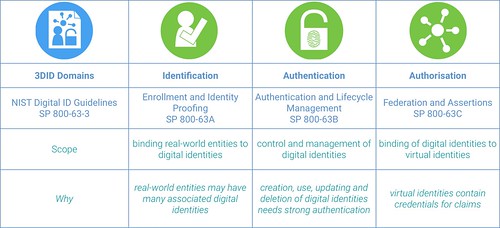
The NIST Digital Identity Guidelines use a three part model to create a standardised framework for dealing with the digital identity.

The NIST guidelines break up digital identity management into three sections: enrollment and identity proofing, authentication and life cycle management and .

From NIST’s digital identity deadline approaches — GCN

If that breakdown sounds familiar to blog readers, it’s because it is congruent with the “Three Domain Identity” (3DID) model that we developed a few years ago to help our clients to formulate strategies around digital identity. Just as a reminder, the three domains in our model are “identification” (NIST’s enrollment, identity proofing), “authentication” (NIST’s authentication and life cycle management), and “authorisation” (NIST’s federation and assertions). I made a handy “cut out n’ keep” graphic. 

xxx

The Three Domain Identity (3DID) Model//embedr.flickr.com/assets/client-code.js 

So, it seems to me that the 3DID model provides an excellent basis for government and business to establish a shared digital identity paradigm.

Design a site like this with WordPress.com
Get started