The Royal Mint and CME to launch digital gold on blockchain

xxx

In the UK, there have been robberies in which large quantities of gold and silver have been stolen from homes (here’s some I wrote about a few years ago)

xxx

Why would anyone mess about with physical gold that you can drop, lose, have stolen etc. And I bet it’s hard to buy anything from Amazon with it. I’m more than happy for people to send me gold (you’re welcome to try the experiment) but generally speaking I’d prefer the dematerialised version sent to my Goldmoney account.

From Just popping out to get some gold | Consult Hyperion

xxx

Even i


xxx

A return to the gold standard may be impractical or even undesirable, but the idea of new technology monetising the store of value that is gold seems altogether a different proposition.

From There have been worse ideas, surely? | Consult Hyperion

xxx


xxx

The Royal Mint and CME Group, the diverse derivatives marketplace, are collaborating on a “digitised gold offering” which will be traded on a blockchain – to be made available at some point in 2017. The blockchain-based gold product, called Royal Mint Gold (RMG) will transform the way traders and investors trade, execute and settle gold, said a statement.

From The Royal Mint and CME to launch digital gold on blockchain

xxx

xxx

[The Mint] will issue RMG as a digital record of ownership for gold stored at its highly-secure on-site bullion vault storage facility. CME Group will develop, implement and operate the product’s digital trading platform.

From The Royal Mint and CME to launch digital gold on blockchain

xxx

xxx

Douglas Jackson is the Chairman and Founder of e-gold, one of the very first attempts to create an alternative electronic currency based on gold.

From Douglas Jackson, e-gold | Consult Hyperion

xxx

Cash is still king in Japan, and that could be a problem for BOJ, Government & Economy – THE BUSINESS TIMES

xxx

Even though many places now take credit cards, Apple Pay and other forms of cashless technology, the actual amount of notes and coins circulating in the country has doubled in 20 years. And that’s while the economy and population has shrunk.

More than 101 trillion yen (S$1.35 trillion) of cash was circulating at the end of October. It was used for more than 80 per cent of transactions by value in 2014.

From Cash is still king in Japan, and that could be a problem for BOJ, Government & Economy – THE BUSINESS TIMES

xxx

Blogoff – The Curse of Cash – Philosophy of Money

xxx

What I expect most non-economists reading The Curse of Cash are confounded by is not the idea of abolishing physical notes and coins – on many levels this is appealing, particularly its consequences for criminal activity. No, what’s bizarre is his insistence on charging negative interest rates on cash to stimulate demand under deflation.

From Blogoff – The Curse of Cash – Philosophy of Money

xxx

Just 35,000 personnel to replenish ₹16 lakh crore in ATMs | business-news | Hindustan Times

xxx

“Re-configurations takes time so it has to be done one by one. Things should be normal in ten days. You have to understand there are 2 lakh ATMs in the country but there are only three to four vendors.”

From Just 35,000 personnel to replenish ₹16 lakh crore in ATMs | business-news | Hindustan Times

xxx

Banks to hire retired officials, extend working hours to stack up new currency notes in ATMs, branches | Business Standard News

xxx

With largest ATM network in the country under its wing, SBI handles on an average 10 million withdrawal transactions involving cash worth Rs 2,800 crore every day.

From Banks to hire retired officials, extend working hours to stack up new currency notes in ATMs, branches | Business Standard News

xxx

Blockchain sprint!

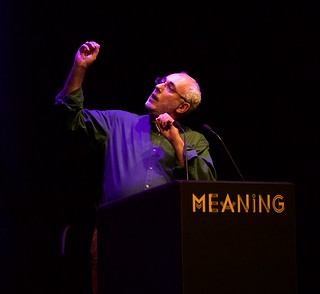
Well, that was the fun. The nice people at the Meaning Conference gave me 13 minutes to try to explain what a blockchain technology is, what blockchains might do, and what the implications might be, to an audience of largely creative people. Quite a challenge.

Meaning2016-DaveBirch//embedr.flickr.com/assets/client-code.js 

Since they were creative types, I thought I ought to frame my explanations with poetry rather than mathematics. I decided to start with the Ur-statement of ordered immutability, the Rubiyaat of Omar Khayyam:

“The Moving Finger writes; and, having writ,

Moves on: nor all thy Piety nor Wit

Shall lure it back to cancel half a Line,

Nor all thy Tears wash out a Word of it.”

You can see the revised version of the slide deck here (we accidentally sent the wrong version on the day, but it really didn’t matter). It sets out the revised “4x4x4” model of shared ledgers, so that there is context for talking about the blockchain, and then quickly works through how there are different kinds of blockchains (and bitcoin is only one) and then gets to what I think will be the lasting impact: ambient accountability, new kinds of transaction environments where traditional auditing and policing are taken care of by the environment itself.

Meaning2016-DaveBirch2//embedr.flickr.com/assets/client-code.js 

In order to explain my focus on ambient accountability, we went back to poetry, this time with T.S. Eliot and choruses from The Rock (1934).

“They constantly try to escape

From the darkness outside and within

By dreaming of systems so perfect that no one will need to be good.”

xxx

Meaning2016-Crowd

//embedr.flickr.com/assets/client-code.js

They were kind to me with their feedback, although going back over the presentation I’m a little disappointed with it. I think I can do better to bring the new world of the shared ledger to the general audience. So I’d appreciate your feedback on two elements of the presentation. First, does the six layer “real world ledger” model help with the discussion or is it an unnecessary complications and second do the example ledgers presented across those six layers make sense? I want to quickly show the different types of ledger in one slide.

Strong Customer Authentication in the Payment Services Directive 2 – Bentham’s Gaze

xxx

This security/usability trade-off is not inherent to Strong Customer Authentication (SCA), and in fact the opposite is more commonly true: in order for SCA to be secure it must also be usable “because if the security is usable, users will do the security tasks, rather than ignore or circumvent them”.

From Strong Customer Authentication in the Payment Services Directive 2 – Bentham’s Gaze

xxx

Design a site like this with WordPress.com
Get started