xxx
n 1822 Turner, a Bank clerk, stole £10,000 by altering the transfer book. The rascal, however, was too clever for the Bank, and escaped.
xxx
A library of snippets
xxx
n 1822 Turner, a Bank clerk, stole £10,000 by altering the transfer book. The rascal, however, was too clever for the Bank, and escaped.
xxx
xxx
A regular occurrence in London, when asking for a fare receipt, is an offer of a couple of unsigned receipts or an offer to put any figure down. The taxi driver keeps no duplicate record of the transaction. This deprives the taxman of the cab driver’s tax and encourages the customer to cheat their employer and HM Revenue & Customs. This conspiracy to defraud has been going on for decades.
An Uber receipt clearly states the origin and destination of a journey and the price paid. This eliminates fraud. As an employer I trust an Uber receipt, but view a licensed taxi receipt with suspicion.
From How black cab drivers and passengers collude to cheat the taxman
xxx
As my colleague Neil McEvoy and I wrote in the DEMOS Quarterly way back in 1996
Endogenous money is money created within a market whereas exogenous money is money created by some outside authority and imposed on a market. We’re used to the second – where the outside authority is the government – and have forgotten about the first, but pressures on the monetary system may have reached the point where a change is inevitable.
xxx
xxx
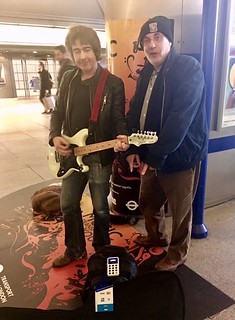
Developed by Carsten van Berkel and Stefan Leendertse of N = 5, an Amsterdam-based advertising agency, the contactless payment jacket allows people to donate 1€ to the wearer using their contactless smart card.
From Amsterdam Introduces Contactless Payment Jackets for Beggars | Oddity Central – Collecting Oddities
xxx
 //embedr.flickr.com/assets/client-code.js
xxxx
xxx
The fate of a defaulted $45 million Chinese corporate bond sold through an Alibaba-backed online wealth management platform was thrown into doubt on Monday… China Guangfa Bank Co Ltd (CGB) said guarantee documents, official seals and personal seals presented by the insurer of the bonds “are all fake” and that it has reported the matter to the police.
From China bank calls documents fake after bond default on Alibaba-linked platform | Reuters
xxx
xxx
In a similar vein, Barclays customers will tap their PIN into a keypad mounted on the card which will create a range of security ciphers.
The codes will be generated at a timed interval by a tiny clock and appear next to the signature strip.
This is pretty much what the card will look like I think.

Actually, I’m being a little naughty here. That picture is actually of the Visa SuperSmartCard, produced by Toshiba back in 1986, but I imagine the Barclays one will work in pretty much the same way.
xxx
Unified Payment Interface, or UPI, provided by various banks could be considered safer than other modes in this respect. In case of UPI, one needs to enter only the Virtual Payment Address, or VPA, of the recipient, which is more secure and easy than sharing credentials such as account numbers and IFSC codes.
xxx
xxx
Financial services companies, for example, are finding that the private blockchain networks they’ve set up with a limited number of trusted counterparties can significantly reduce transaction costs.
This is not at all clear to me. If anyone has any actual figures about this I would be genuinely interested in looking at them.
xxx
“Miles and points are cash, that’s what we teach people, and it’s certainly nice when the credit card companies are giving you $1,000, $1,500, $2,000 for getting a single credit card”
xxx
There was interesting discussion on Twitter the other day (as there often is) about the relationship between identity and reputation. The discussion was in the context of “fake news” but it raised a number of general points about reputation and the reputation economy that are worth reflecting on. One particular point was whether a reputation must link one-to-one with a confirmed identity in order for the reputation to be useful. I think it doesn’t, and I can point to a particular case study which I think triggered a lot of this kind of thinking in my own mind.
Many many years ago in the early days of electronic commerce and digital money and online payments and all those good things, I came across a mailing list (I’m not sure what it was called it at the beginning but it later became known as the e$ list) that I found very useful. The list had links to interesting stories, discussions and very well-informed debate on the then very new topics of money and transactions in an interconnected world. One day, there was a message on the mailing list saying that it was going to be discontinued because the person or people running it couldn’t continue to do it as voluntary effort, so without some form of sponsorship they would have to stop.
Since my colleagues and I found a list very useful we stepped up to the plate and agreed to provide some sponsorship money. The list operator asked us to send the money to an ISP to cover their charges for the next six months or the next year or something. This we did and thus we became sponsors.
mailing lists (sponsored by Hyperion & C2Net Software)
Now, it was only afterwards that I realised that we had just been through a commercial transaction with an entirely unknown counterparty. I didn’t know whether the mailing list was run by a person, a group of students, a rival company or agents of a foreign power trying to collect contact details of key players in the electronic money field. I didn’t know, and I didn’t care. The quality of the list established over a period of months (in other words, the reputation of the list) was the necessary ingredient for the transaction to take place. Of course, I later discovered that the list was curated by “Robert Hettinga” but that meant nothing to me and I had no clue whether he was a real personal not (he is: I’ve met him!).
My point is that reputation is sufficient. I did not know who or what was providing the news, but the news and the discussions were of sufficient quality to merit our money.

 Snippings