UK’s porn age checks set ‘dangerous’ precedent (Wired UK)

xxx

A consultation from the Department for Culture Media and Sport said “commercial providers” of porn should have verification controls to stop under 18s viewing the content. Companies that don’t comply may face fines from a new porn regulator, or have their websites shut down.

From UK’s porn age checks set ‘dangerous’ precedent (Wired UK)

xxx

Airbnb renter fooled neighbor, refused to leave – Business Insider

xxx

Another neighbor and co-owner of the building, Sandeep Hingorani, lives in the top-floor studio — and for the past 10 months he has also rented Huang’s unit, despite her not wanting him to live there.

The problems started when an Airbnb user, “Jim Tako,” asked to rent Huang’s apartment.

From Airbnb renter fooled neighbor, refused to leave – Business Insider

xxx

Onfido: Figuring out who perfect strangers are

xxx

Whether that’s listing a spare room on Airbnb, driving for a few hours a week on Uber, completing a few DIY jobs on TaskRabbit or cleaning someone’s flat via Hassle.

And as a customer of these services you’re required to trust that the individual you let into your house is as trustworthy as the stranger driving your car.

From Onfido: Figuring out who perfect strangers are

xxx

Onfido run this data through an instant checking system, pulling the numbers and writing straight off your passport to check it is genuine and not stolen, and then cross-referencing this data with other databases.

From Onfido: Figuring out who perfect strangers are

Ah. But this isn’t quite the same thing. If you are my Uber driver, there are lots of things I want to know about you, but who you are isn’t one of them. I want to know you a have clean driving licence, that the car is insured, that you don’t play loud music and annoy people with it. All sorts of things. Who you really are?  Whatever. That’s none of my business anyway. One thing I really do want to know is that you are actually the driver with the five star reviews that you say you are, whether I know your real name or not.

xxx

Trust is about much more than money; it’s about human relationships, obligations, experiences, and about anticipating what other people will do.

From In third parties we (mis)trust? » Banking Technology

xxx

There is no excuse for not taking cards

So we went to the pub. For lunch. Seven of us. Say £20 per head. £100+ quid. Say £50 quid gross for the pub. Colleague goes to order food and drinks and pay at the bar. Apologetic barmaid comes over to explain that their “card machine” is down, so she can only accept cash. Under normal circumstances I would have simply walked out, feeling it wholly inappropriate to reward such a poorly managed establishment and, as a functioning actor in a capitalist economy, done my duty to depress their lunchtime takings.

Here’s what we wanted to say:

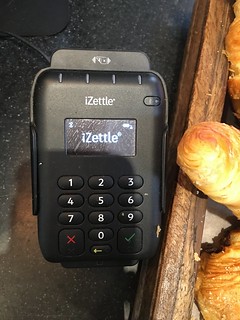
This is absurd. This is 2016 not 1916. Your card machine is down? Well, so what! Are you seriously telling me that mein host has no mobile phone number capable of registering for PingIt or PayM? That none of the staff or the pub itself have a PayPal account that I can send the money to? That neither the owners nor managers not contingency planners thought to tuck an iZettle behind the bar to use when the clunky and expensive GPRS terminal fails for one reason or another? This is a joke. Either the person responsible for the finances of this dive should be sued by the shareholders for negligence or I suspect your card machine isn’t broken at all, you’re just keeping the cash off the books to save on the paperwork. Either way, I’ve been thrown out of better places than this, so I’m taking my business elsewhere. Good day to you.

Of course, being English, what we actually said was:

oh sorry, don’t worry about it, we’ll go and get some cash

A helpful barfly explained that there was a free ATM only a couple of minutes walk away, so a scouting party was sent out to forage for cash while we waited back in the comfort of the lounge.

iZettle at Bakery

//embedr.flickr.com/assets/client-code.js

There is absolutely no excuse for not taking electronic payments, even for those eking out a living in the margins of the crumbling ruins of post-Brown Britain.

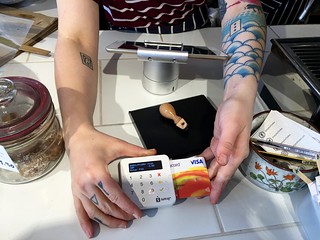
Sumup

//embedr.flickr.com/assets/client-code.js

xxx

The Great EMV Fake-Out: No Chip For You! — Krebs on Security

xxx

My own decidedly unscientific survey involved a shopping spree one recent morning to no fewer than seven different retail locations, which revealed exactly seven different chip-capable payment terminals instructing customers to “Please Swipe Card.”

From The Great EMV Fake-Out: No Chip For You! — Krebs on Security

xxx

Crooks put their own bank details on stolen school fee letters to steal 1000s of pounds | Daily Mail Online

xxx

Parents who did not know the letters had been tampered with then paid the school fees into the crooks’ bank accounts without realising.

From Crooks put their own bank details on stolen school fee letters to steal 1000s of pounds | Daily Mail Online

They’re not smart and they’re not contracts

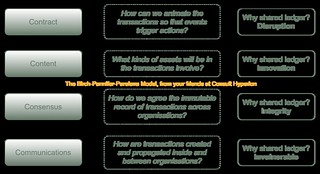
I know, I know, they’re not smart and they’re not contracts. But in the well-known Birch-Pannifer-Parulava model for thinking about shared ledgers from a business perspective (a model that continues to be refined, even as I type), we’ve stuck with the term “contract” on our 4C layer, more for marketing reasons that anything else (clients like the “4C” model and find it easy to remember).

 Birch-Pannifer-Parulava Four Layer Model//embedr.flickr.com/assets/client-code.js

So I’m happy to continue to use the word contract But it does bother people, and I think we need to discuss it.

I think folks know this and that’s why there’s been a subtle effort lately to avoid “contract” and “smart contract” in favor of more use-specific labels like “Distributed Application” or “DAO.”

From Upacking the term ‘Smart Contract’ — Medium

From Upacking the term ‘Smart Contract’ — Medium

I did have an effort to introduce the new term LAPPS (i.e., Ledger APPlicationS) so as to have a simple and natural term, but it doesn’t seem have gained much traction. I suppose the whole “smart contract” thing has just become too embedded. But I agree with the author, and others, that it’s time to pick up the cudgels and fight a rearguard action before it is too late.

This is probably a good idea. Calling something that is really just an application a ‘contract’ or ‘smart contract’ sends signals you may not want to send. You don’t, for example, want users of your Hello World app to think they’re [entering a legal contract]

From Upacking the term ‘Smart Contract’ — Medium

So. LAPPS it is for the time being.

Fintech firms want to open accounts at the Bank of England – Telegraph

The the U.K.’s Faster Payments Service (FPS) has been very successful. The ability to send money from one account to another account instantly is actually quite transformational, but I still think that the full impact has yet to be felt. As we move into 2018 and the world of the newly-published Open Banking Standard, PSD2 and APIs then we will see instant payments built in to the applications that support our everyday lives. This morning when I caught the bus to work the cost of the bus ticket was charged to one of my credit cards, which meant that the bus company had to store my card information and that I had to remember the three digit code on the back of the card to complete the purchase. In the future, I will tell the bus company I want a ticket and put my thumb on the home button of my iPhone and that will be that. The money will be sent from my bank account to the bus company’s bank account with no delays, intermediaries or additional friction. As I said before, there will be a push for push.

Since it is such a big deal, it is of course important who has access to the instant payments networks. The government is very keen to see more competition in the retail payments space and for this reason it wants to facilitate access to core payment systems, such as FPS. The opening up of access has already started. You might remember that last year, access was opened up to a new kind of aggregated access layer under the “New Access Model”.

The New Access Model, first published in December 2014, sets out proposals to enable technology vendors to offer technical access to Payment Service Providers (PSPs) by adding to their existing accounting platform technology, or providing a managed solution to either a single or multiple PSPs.

From New access market for Faster Payments gains traction | Faster Payments

This new model gave technology companies with experience in payments the ability to create systems to connect directly to FPS and then offer this connection to other players. These new offerings, including VocaLink’s PayPort service, are a terrific step forward and they make it very easy for new entrants to get up and running. Earlier this, in fact, PayPort made access for new entrants even easier through their partnership with Raphael’s Bank.

As a member of the Faster Payments Scheme, Raphaels Bank will be able to provide other payment service providers with access to the UK’s core payments infrastructure through VocaLink’s PayPort service.

From VocaLink Connect – VocaLink partners with Raphaels Bank on Faster Payments

So now, new entrants who sign for agency access with Raphaels can use PayPort to launch their services. But access may well be opened up even further. There are plenty of non-bank players out there who want to have access to the infrastructure and this week the UK’s Emerging Payments Association presented a report to arguing that, under the appropriate licence conditions, non-banks should be allowed access to instant payments infrastructure through the use of a new kind of limited pre-funded settlement account at the Bank of England. In essence, a Facebook or a Google would be allowed accounts that they would load up with a few million quid in the morning and then use throughout the day. Under this kind of option you would be able to send money from your bank account to a friend on Facebook messenger in a jiffy. Facebook and other tech players could use PayPort to connect to FPS, giving them integration and all the services they need at the drop of hat.

Tech firms are in talks with the Bank of England to secure settlement accounts, a privilege only currently on offer the banks. The accounts would help give the finance technology (fintech) firms access to the payments system, the infrastructure which currently underlies much of Britain’s financial services industry.

From Fintech firms want to open accounts at the Bank of England – Telegraph

Why am I highlighting this? Well, the interpersonal services that deliver instant payments at the moment (such as PayM, which has more than three million registered users) are just a toe in the water! Imagine what some of these new tech players will be to do with those services when they integrate them with social media, mobile apps, retail platforms, public services and other organisations and businesses. I’m looking forward to some real innovation in this space and opening up access under the right conditions will energise the whole sector.
Design a site like this with WordPress.com
Get started