What’s wrong with finance

xxx

What is the finance sector supposed to do? Essentially, it needs to perform a number of basic economic functions. First and foremost, it operates the payments system without which most transactions could not occur. Secondly, it channels funds from individual savers to the corporate sector so the latter can finance its expansion. In doing so, it does the highly useful service of maturity transformation; allowing households to have short-term assets (deposits) while making long-term loans. It also creates diversified products (such as mutual funds) that help to reduce the risk to savers of catastrophic loss. Thirdly, it provides liquidity to the market by buying and selling assets. The prices established in the course of this process are a useful signal of which companies offer the most attractive use for capital and which governments are the most profligate. Fourthly, the sector helps individuals and companies to manage risks, whether physical (fire and theft) or financial (sudden currency movements).

From What’s wrong with finance

xxx

Tap-and-go threatens cash economy – Convenience & Impulse Retailing

xxx

“Around one-third of all point-of-sale transactions were conducted using contactless cards in 2016… As a share of card payments only, nearly two-thirds of all point-of-sale payments were contactless in 2016.”

From Tap-and-go threatens cash economy – Convenience & Impulse Retailing

xxx

From Liverpool to east London: Local currencies are making a comeback

xxx

Millennials’ distrust of British banks, and a growing interest in supporting local communities, has helped spawn a new crop of local digital currencies, with the Liverpool pound launching earlier in the year, and the east London pound debuting last month.

From From Liverpool to east London: Local currencies are making a comeback

xxx

Expectations on PSD2 interactions between banks and fintechs clarified by UK Treasury

xxx

Though there are differences in scope between the two regimes, consideration is being given to how open application program interfaces (APIs) being developed under the open banking initiative could be used to support access to payment accounts and data by PISPs and AISPs under PSD2.

From Expectations on PSD2 interactions between banks and fintechs clarified by UK Treasury

xxx

Families left stranded after £10,000 villas did not exist | Daily Mail Online

xxx

When you search on Google, it orders results by what it believes to be the most useful and relevant. A website’s rank has become a common barometer for how high-quality or trustworthy a company is.

From Families left stranded after £10,000 villas did not exist | Daily Mail Online

Oh dear. A website’s rank has absolutely nothing to do with either quality or trustworthiness. It’s no wonder people get taken in like this, but since we have no trust infrastructure and no way of connecting people to it via the user interface even if we did, it’s hard to see how things will improve.

What would have to be in place to fix this sort of problem. Well, first of all, when you go to a website offering holiday villas you should be able to tell whether someone knows who it is that is behind the site. 

POST The government is completely and utterly wrong about surcharging

When I was in sunnier climes earlier this month, I was asked a couple of times about a particularly bonkers British government policy announcement concerning card payments. More than one person from overseas regulators asked me about it, in fact. They asked me if I could explain our government’s reasoning behind their policy announcement about card payment surcharges. Which was:

From January next year, businesses will not be allowed to add any surcharges for card payments. The worst offenders currently are airlines and food delivery apps, and small businesses which typically add a fee for cards. In 2010 alone consumers spent £473m on such charges, according to estimates by the Treasury.

From Credit and debit card surcharges to be banned – BBC News

Unfortunately, I cannot. This is just plain dumb. If you are going to interfere in a market and start price-fixing, then you should do it to increase the net welfare, not to provide a hidden subsidy to the well-off. I imagine what happened is that the partner of a government minister went online to book a mini-break to Dubrovnik, searched for the cheapest flights, went to pay with their black Amex card and got upset about being charged a surcharge that they could well afford to pay. Next thing you know, it’s government policy that rich users of rewards cards must be subsidised by everyone else. Baffling.

The move will save British consumers hundreds of millions of dollars

From U.K. Bans Credit Card Surcharges, Calling Them A ‘Rip-Off’ : The Two-Way : NPR

Really? How? The credit card system (and all the legal protections that come with it) do not suddenly become free. British Airways still has to pay a merchant service charge (MSC) to their acquirer and the acquirer still has to pay an interchange fee (already capped by the EU). If British Airways can’t charge me an extra £2.50 for using my credit card so that I can get extra Avios, then they will simply add £1 “booking fee” or whatever to all tickets. Now, people who pay with their debit cards (who used to pay nothing extra) are paying an extra £1 and I’m paying £1.50 less and still getting my Avios.

There are two issues here: should merchants be allowed to surcharge (hint: yes) and should the government interfere in the surcharging (more on this later).
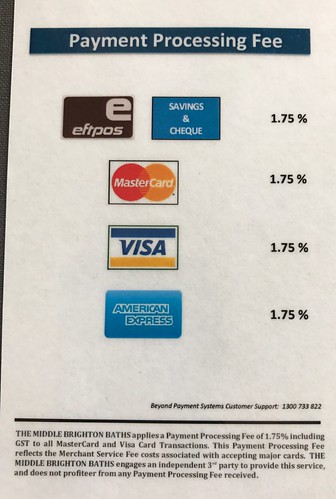
 Surcharging in Melbourne

xxx 

xxx 

Ed Sheeran takes on ticket touts and cancels 10,000 gig tickets sold by unofficial resale sites

xxx

Fans who purchased tickets when they went on sale will have to arrive at their gig venue with the booking confirmation, a valid form of ID and the credit card used for the purchase (or a photocopy).

From Ed Sheeran takes on ticket touts and cancels 10,000 gig tickets sold by unofficial resale sites

How are the bouncers on the door at an Ed Sheeran concert supposed to tell a real Portuguese fishing licence from a fake one? And what happens if I use my credit card to buy a ticket as a present for someone?

There is a solution, of course: put the tickets on a shared ledger and then sell them on eBay so that the market clears. If Ed wants fans to have tickets for £10 instead of £100, then he can buy the £100 tickets in the auction and re-sell them himself using whatever identification and authentication system he wants. Ticket “scalping” is a natural response to a broken market.

POST The non-banks are in

You might remember that last year I wrote about giving non-banks access to the UK payment infrastructure.

There are plenty of non-bank players out there who want to have access to the infrastructure and the UK’s Emerging Payments Association recently presented a report to arguing that, under the appropriate licence conditions, non-banks should be allowed access to instant payments infrastructure through the use of a new kind of limited pre-funded settlement account at the Bank of England.

From Access | Consult Hyperion

Well, this is exactly what is going to happen.`

The widely-trailed move is expected to open up a competitive space which has long been the preserve of the UK’s biggest incumbents, providing non-bank PSPs with direct access to the UK’s sterling payment systems that settle in central bank money, including Faster Payments, Bacs, Chaps, Link, Visa, and, once live, the new digital cheque imaging system.

From Bank of England comes good on promise to provide non-banks with dir…

xxx

Design a site like this with WordPress.com
Get started