xxx
The UK’s largest nine banks have been given a year to develop and adopt an Open Banking API interface for customer data sharing
xxx
A library of snippets
xxx
The UK’s largest nine banks have been given a year to develop and adopt an Open Banking API interface for customer data sharing
xxx
xxx
One of my favorite moments from Star Trek is in ST IV: The Voyage Home, when Kirk and the gang are stranded in 1980s San Francisco. They try to board a Muni bus and are promptly turned away.
Spock: What does it mean, “exact change”? Kirk: They’re still using money. We need to find some.
Not only is money a foreign concept to the crew, it’s so foreign they didn’t even remember it was used in the Twentieth Century.
From Why Star Trek’s Future Without Money Is Bogus — Brain Knows Better
xxx
There’s a lot of pressure on me to be in two places at once these days, so I was happy to see Google file and trivial and obvious “patent” on how to help busy executives achieve this using new (well, pretty old, actually) technology by gluing a wireless web cam to a drone.
Google is hoping to patent a small videoconferencing “telepresence” drone for collaborating with colleagues from remote locations, according to an application that was made public today. The drone is designed to fly indoors and move from room to room.
From Pocket: Working from home? Google wants to create a drone to go to meetings for you.
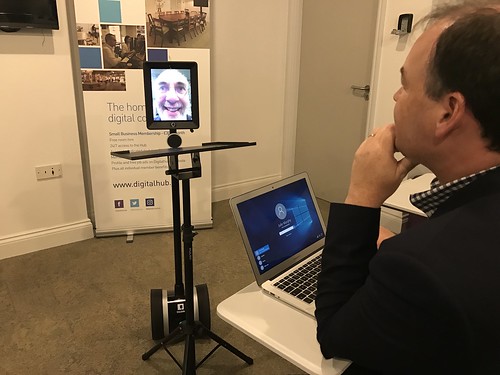
Not only is this more trivial than it appears at first glance, it already exists in essence. Here, for example, is photographic proof of me annoying Tony Moretta, the CEO of Digital Jersey, in precisely this fashion by sending a meeting bot (an iPad glued to a Segway, basically) to talk to him while I sat comfortably with my iPhone in a distant location (well, the room next door to be honest, but you get the point).
//embedr.flickr.com/assets/client-code.js
As Tony himself pointed out, this implementation suffers from the Dalek Deficiency, in that he can escape my dreary lecture about the difference between a digital currency and a cryptocurrency by heading downstairs to the gents. Fair point. But with the google-powered flying Drone Dave there will be no escape (unless they’ve fixed the door on the gents, of course).
This doesn’t actually solve my problem because although I can attend remote events in this manner, and thus cut down on travel time, I can still only attend one at a time. Surely if Google were being truly creative they would connect their Go-master AI in to the drone so that I could send a bot to the meeting instead of going in person? A great many of the meetings I attend would be adequately served by a bot programmed to deliver a few key phrases at the right juncture. For example:
“What’s in the blocks?”;
“That’s not identificaton, that’s authentication”; and
“There’s no transaction type for doing that on the network”.
That’s should take care of most eventualities. It’s hard enough to tell whether people are actually listening on a conference call or call or not so how we’ll be able to tell whether it’s a bot or a person sitting in by drone will be a whole new ball game. I can forsee a time when we’re going to need a new version of the Turing test specifically for management meetings otherwise one day I will undoubtedly end up like this guy who is playing World of Warcraft when he realises that he is the only actual human playing the game and all of the other players are bots. Pay attention because one day this will happen in a meeting about EMV Next Generation or something.
My only goal left in life is to become the Leroy Jenkins of Consultants. In the meantime, however, and I am beginning to sound like a broken record (note to younger readers: I mean of the vinyl kind) on this one, I will merely point out once again that IS_A_PERSON may turn out to be the most valuable credential in the very near future. If this is true, then Consult Hyperion should seek out a market that needs such a credentials right now and work out a way for our clients to provide this as a business, right? My candidate? Internet dating.
The online dating industry generates around $2 billion in yearly returns in the United States only, with over 15 percent of US adults reporting utilizing online dating services and/or mobile dating apps. Statistics reveal that close to 40 percent of couples run into each other through common friends in spite of the rise of online dating.
It’s a mass-market mainstream business that would be even bigger if it wasn’t rife with fraud (and, as you will recall from the Ashley Madison hack, bots).
xxx
Mobile ID, a digital authentication system that is implemented into the user’s mobile SIM card, is ready to be used throughout Europe, according to Hubert Pujol of the French national cybersecurity authority ANSSI.
xxx
Published in The Futurist Magazine in September 2012 as part of a compilation of pieces envisioning life in 2100, this article asks if we will still have money in 2100, and speculates on what form it may take if we do
It is quite likely that we will still have money in 2100, but it may not be issued by governments any longer.
snippet
xxx
More consumers became victims of identity fraud last year than at any point in more than a decade despite new security protections implemented by the credit-card industry
From Credit-Card Fraud Keeps Rising, Despite New Security Chips—Study – WSJ
xxx
xxx
The online dating industry generates around $2 billion in yearly returns in the United States only, with over 15 percent of US adults reporting utilizing online dating services and/or mobile dating apps. Statistics reveal that close to 40 percent of couples run into each other through common friends in spite of the rise of online dating.
xxx
snippet
When Sweetgreen opened in 2008, 40% of its take was cash. By 2016, that value dropped to between 10% and 15%.
snippet
Wow. Consult Hyperion’s 20th annual Forum, Tomorrow’s Transactions 2017, will be held at the America Square conference centre in London on 26th/27th April. The Forum, thanks to the wonderful support from our friends at Vocalink, PaySafeGroup, WorldPay and Olswang, will once again provide a unique environment for learning, investigation, discussion and debate about the future of electronic transactions. The future of people, businesses and government in the post-industrial online and interconnected economy.
This year’s invited keynote will be given by Professor Lisa Servon, one of the world’s leading authorities on financial and social inclusion. All delegates will receive a copy of Lisa’s new book “The Unbanking of America: How the New Middle Class Survives”.
Other speakers and panelists include Gilad Rosner (IoT Privacy Forum), Nick Telford-Reed (WorldPay), , Amy Parsons (Discover), Sandra Alzetta (Visa), Terry Cordeiro (Lloyds Bank), Jane Zavalishina (Yandex Data Factory), Tim Jones (Mondex co-founder), Will Judge (MasterCard), Katie Evans (Money and Mental Health), Vasily Suvorov (Luxoft), David Rennie (gov.verify), Emma Lindley (Innovate Identity), Andy Tobin (Evernym), Ben Whittaker (Masabi) and other people who are shaping the future of retail electronic transactions right now will be discussing PSD2, shared ledgers, AI, real-time payments, the Internet of Things, financial inclusion, open-loop migration and everything else shaping strategy across a variety of industries.
In addition to a fireside chat about instant payments with David Yates (CEO, VocaLink) and Ron Kalifa (Vice Chairman, WorldPay), there will be an introductory keynote by Dave Birch (our Director of Innovation), the judging of the annual Future of Money Design Award for artists and at the end of the first day a 20th anniversary drinks and networking reception.
You’d be mad to miss it.
As always, the Forum is limited to 100 people so run, don’t walk, to our web site and buy a place right now. I look forward to seeing you all there.
xxx
Brands can send over styling tips and recommendations, or offer loyalty points and discounts. A top can present its wearer with some trousers it might suit. A pair of running shoes can signal when they are worn out.
xxx

 Snippings