Salad Days

I’m not sure if you’re supposed to have a favourite supply chain fraud or not but I do, and it is the famous case of the vegetable oil that almost bankrupted American Express (and went some way toward making Warren Buffet a multi-billionaire). The essence of the story is that a conman, Anthony “Tino” De Angelis, discovered that people would lend him money on the basis of commodities in the supply chain. His chosen commodity was vegetable oil (see How The Salad Oil Swindle Of 1963 Nearly Crippled The NYSE). Amex had a division that made loans to businesses using inventories as collateral. They gave De Angelis financing for vegetable oil and he took the Amex receipts to a broker who discounted them for cash. So he had tanks of vegetable oil and Amex had loaned him money against the value of the oil in those tanks, the idea being that they would get the money back with a bit extra when the oil was sold on. Now as it happened, the tanks didn’t much contain oil at all. They were mostly water with a layer of oil on top so that when the inspectors opened the tanks and looked inside they saw oil and signed off whatever documentation was required. Eventually the whole scam blew up and nearly took Amex down, enabling the sage of Omaha to buy up their stock and make a fortune.

Fortunately for us and unfortunately for conmen like Tino, the supply chain is one of the many industries that the blockchain is going to disrupt. As my good friend Michael Casey and his co-author Pindar Wong explain in their recent Harvard Business Review piece on the topic (Global Supply Chains are about to get Better, Thanks to Blockchain in HBR, 13th March 2017), blockchain technology allows computers from different organisations to collaborate and validate entries in a blockchain. This removes the need for error prone reconciliation between the different organisation’s internal records and therefore allows stakeholders better and timelier visibility of overall activity. The idea discussed in this HBR piece (and elsewhere) is that some combination of “smart contracts” and tagging and tracing will mean that supply chains become somehow more efficient and more cost-effective.

An aside. I put “smart contracts” in quotes because, of course, they are not actually contracts. Or smart. Bill Maurer and DuPont nailed this in their superb King’s Review article on Ledgers and Law in the Blockchain (22nd June 2015), where they note that smart contracts are not contracts at all but computer programs and so strictly speaking just an “automaticity” on the ledger. (Indeed, they go on to quote Ethereum architect Vitalik Buterin saying that “I now regret calling the objects in Ethereum ‘contracts’ as you’re meant to think of them as arbitrary programs and not smart contracts specifically”.)

Using the blockchain and “smart contracts” sounds like an excellent idea and there’s no doubt that supply chain participants are taking this line of thinking pretty seriously. Foxconn (best known as the makers of the iPhone) are a recent case study. In March 2017 they demonstrated a blockchain prototype that they used to loan more than six million dollars to suppliers. I should note in passing that the article didn’t make it clear why they were using a blockchain (as opposed to any other form of shared ledger) or why they were using a shared ledger rather than a database but, like Merck and Walmart and many others, Foxconn is a serious business that sees promise in the technology so we should take the case study seriously.
 
While I was reading about Foxconn, and a couple of other related articles in connection with a project for a client, I started to wonder just how exactly would the supply chain industry be disrupted? How would the blockchain have fixed the salad oil problem? It’s very easy to think of a fancy fintech setup whereby smart contracts took care of passing money from the lender to the conman when the tanks were certified by the inspectors but as sceptical commentators (e.g., the redoubtable Steve Wilson of Lockstep) frequently point out, transactions using blockchain technology are only “trustless” insofar as they relate to assets on the blockchain itself. As soon as the blockchain has to be connected to some real-world asset, like vegetable oil, then it is inevitable that someone has to trust a third-party to make that connection.

Trusting these third parties can be a risk. Another of my favourite scandals (I have quite a few, I should have mentioned that) is the horsemeat scandal that swept Europe on the 50th anniversary of the salad oil scandal. Basically horsemeat was being mixed with beef in the supply chain and then sold on to the suppliers of major supermarkets in, for example, the UK. One of the traders involved was sentenced to jail for forging labels on 330 tonnes of meat as being 100% beef when they were not. Once again, I am curious to know how a blockchain would have helped the situation since the enterprising Eastern European equine entrepreneur would simply have digitally-signed that the consignment of donkey dongs were Polish dogs and no-one would have been any the wiser. It is not clear how a fintech solution based on blockchains and smart contracts would have helped, other than to make the frauds propagate more quickly.

The reason that I am interested in scandals like this one is that the tracking of food features as a one of the main supply chain problems that advocates hope the blockchain will solve for us. Work is already under way in a number of areas. I understand that Walmart have carried out some sort of pilot with IBM to try to track pork from China to the US and another pilot was used to track tuna from Indonesia all the way to the US. But if someone has signed a certificate to say that the ethically-reared pork is actually tuna, or whatever, how is the shared ledger going to know any different? A smart contract that pays the Chinese supplier when the refrigerated pork arrives in a US warehouse, as detected by RFID tags and such like, has no idea whether the slabs in the freezer are pork or platypus.

If you do discover platypus in your chow mein, then I suppose you could argue that the blockchain provides an immutable record that will enable you to track back along the supply chain to find out where it came from. But how will you know when or where the switcheroo took place? Some of the representations of the blockchain’s powers are frankly incredible, but it isn’t magic. It’s a data structure that recapitulates the consensus of its construction, not a Chain of True Seeing with +2 save against poison. So is there any point in considering a form of shared ledger technology (whether a blockchain or anything else) for this kind of supply chain application? Well, yes. We think there is.

Let’s go back to the first example, the great vegetable oil swindle. Had American Express and other stakeholders had access to a shared ledger that recorded the volumes of vegetable oil being used as collateral, the fraud would have been easily discovered.

“If American Express had done their homework, they would have realized that De Angelis’s reported vegetable oil ‘holdings’ were greater than the inventories of the entire United States as reported by the Department of Agriculture. “

via How The Salad Oil Swindle Of 1963 Nearly Crippled The NYSE

Interesting. So if the amounts of vegetable oil had been gathered together in one place, the fraud would have been noticed. What could that one place be? A federation of credit provider’s databases? A shared service operated by the regulator? Some utility funded by industry stakeholders? How would they work? What if the stakeholders instead of paying some third party to run such a utility used a shared ledger for their own use? It would be as if each market participant and regulator had a gateway computer to a central utility except that there would be no central utility. The gateways would talk to each other and if one of them failed for any reason it would have no impact on the others. That sounds like an idea to explore further.

How might such a ledger might operate? Would American Express want a rival to know how much vegetable oil it had on its books? Would it want anyone to know? The Bank of Canada, in their discussion of lessons learned from their first blockchain project, said that “in an actual production system, trade-offs will need to be resolved between how widely data and transactions are verified by members of the system, and how widely information is shared”. In other words, we have to think very carefully about what information we put in a shared ledger and who is allowed to say whether that information is valid or not. Luckily, there are cryptographic techniques known as “Zero Knowledge Proofs” (ZKPs) that can deliver the apparently paradoxical functionality of allowing observers to check that ledger entries are correct without revealing their contents and these, together with other well-known cryptographic techniques, are what allow us to create a whole new and surprising solution to the problem of the integrity of private information in a public space.

It is clear from this description that a workable solution rests on what Casey and Wong call “partial transparency”. At Consult Hyperion we agree, and we borrowed the term translucency from Peter Wagner for the concept. For the past couple of years we have used a narrative built around this to help senior management to understand the potential of shared ledger technology and form strategies to exploit it. Indeed, in some contexts we focus on translucent transactions as the most important property of shared ledgers and as a platform for new kinds of marketplaces that will be cheaper and safer, a position that you can find explored in more detail in the paper that I co-authored with my colleague Salome Parulava and Richard Brown, CTO of R3CEV. See Towards ambient accountability in financial services: shared ledgers, translucent transactions and the legacy of the great financial crisis.Journal of Payment Strategy and Systems 10(2): 118-131 (2016).

As you might deduce from the title, in this paper we co-opt the architectural term “ambient accountability” to describe the combination of practical Byazantine fault tolerance consensus protocols and replicated incorruptible data structures (together forming “shared ledger” technology) to deliver a transactional environment with translucency. As Anthony Lewis from R3CEV describes in an insightful piece on this new environment, it is much simpler to operate and regulate markets that are built from such structures.

The reconciliation comes as part of the fact recording; not after. Organisations can “confirm as they go“, rather than recording something, then checking externally afterwards.

From Distributed ledgers: “Confirm-as-you-go” | Bits on blocks

In this way the traditional disciplines of accounting and auditing are dissolved, re-combined and embedded in the environment. Smart contracts wouldn’t have disrupted Tino’s business, but ambient accountability would have uncovered his plot at a much earlier stage, when the near real-time computation of vegetable oil inventories would delivered data on his dastardly plot. You’d hardly need Watson to spot that inventories greater than the United States entire annual production ought to be looked into in more detail.

Perhaps we need to shift perspective. It is the industry-wide perspective of the shared ledger, the shared ledger as a regtech, that makes the disruptive difference to supply chains, just as it is the shared ledger as a regtech that will reshape financial markets by creating environments for faster, cheaper and less opaque transactions between intermediaries that have to add value to earn their fees rather than rely on information asymmetries to extract their rent. As the World Economic Forum’s report on the Future of Financial Services says, “New financial services infrastructure built on [shared ledgers] will redraw processes and call into question orthodoxies that are foundational to today’s business models”. We agree, and if you want to make this a reality for your organisation, give me or my colleagues at Consult Hyperion a call. We will provide help, not hype.

Incidentally, the brilliant Maya Zahavi from QED-it will be explaining how ZKPs can transform supply chains at the 20th annual Consult Hyperion Tomorrow’s Transactions Forum on April 26th and 27th in London. Run, don’t walk, over to that link and sign up now for one of the few remaining delegate places and to be kept up-to-date in the future, sign up for our mailing list as well.

[Sincere thanks to my colleague Tim Richards and to my former colleague Salome Parulava for their helpful comments on an earlier draft of this post.]
Fake news: Dow Jones blames technical error for headlines claiming…

xxx

While the implausible nature of the $9 billion price tag may have been a red flag to human traders, Apple did briefly see its stock rise to $158 before settling back down to around $156, raising the possibility that some algos were fooled.

From Fake news: Dow Jones blames technical error for headlines claiming…

xxx

Book review: Big Mind

Perhaps the universe was telling me something, because it seems to me beyond coincidence that I don’t remember hearing the word “homophily” before and yet I’ve just come across it twice in the same day: once when listening to historian Niall Ferguson on the BBC’s Today programme while in the shower and then again a couple of hours later while reading Geoff Mulgan’s new book “Big Mind” on the couch. Homophily means the tendency of people (e.g., me) to tend to congregate online with people who think the same as they do (e.g., the Chancellor of the Exchequer is very probably insane) but worse still in the new online world, also view only “news” (fake or real) that reinforces their position.

We will come back to homophily in a moment.

Geoff’s thesis is that the “collective intelligence” formed from groups of people connected together online functions according to new dynamics. Now, while he notes early on that a more networked world does not automatically means a higher IQ world (in fact, as far as I can see, the general level of idiocy has increased substantially since the early days of the the telegraph and the bulletin board), and that “shared thought is not only knowledge but delusions, illusions and fantasies”, I’m not sure that Snapchat boosts either individual or collective IQs.

Hence I began with caution, and about two thirds of the way through the book I was caught in a terrible English dilemma. I’ve known the author for a long time and admired his work with Demos and NESTA. But I wasn’t enjoying the book and didn’t feel I was getting anything from it. So how could I say that politely?

Luckily I carried on reading and I realised that the first two-thirds of the book is not for people like me who spend their entire lives on LinkedIn and Twitter but for politicians and policymakers who have only the vaguest idea of what these new technologies are and just how different these new dynamics of the collective that they have created is from the collection of individuals that they are used to dealing with.

It’s the last third of the book where Geoff gets into the tough questions. I’d not heard of the “folk theory of democracy” (i.e., that the people are wise and come to the right answer) before but I can say with certainty that it is doomed with the masses so easily subverted through Facebook adverts and clickbait headlines. While it is appealing to hope that new technology is the answer, a means to rejuvenate democracy, I’m not sure. As the author notes, crowds are good at ideas, not judgements.

Do we then give decision making to an elite? Maybe, but the experts aren’t always right even when they are more connected than ever before. I strongly agree with the author’s view that “expertise can entrap”, or to put it another way, foxes make better predictions than hedgehogs, but we don’t seem to be rummaging through the dustbins of knowledge to pick out the good stuff at all. The example the author uses illustrates this rather well: we have more data about health and diet and nutrition than ever before, yet we have an epidemic of obesity. More data does not mean wisdom.

Which leads me to my suspicion is that it isn’t networking people together that is going to help, but networking people with artificial intelligences. As Geoff himself points out, technologies can effectively perform many of the elements of collective intelligence. He references a a Hong Kong investment firm has already invited an AI to join its board and given it the same vote as human board member.

A cabinet of ZX Spectrums could hardly do worse than the flesh and blood version. I laughed out loud when I saw “government is collective intelligence” since there’s precious little evidence of such (“government is muddling through” is more the British way). Geoff has had access to government decision-making process that I have not, so how accurate his characterisation is I can’t say. He certainly right when he says that companies pretend to operate with collective intelligence but actually go by gut feeling rules of thumb (as memorably described in one of my favourite books from last year “Chaos Monkeys”).

Geoff puts forward an interesting thesis but doesn’t completely convince with it. At the end of the book, I was left unsure whether he thinks that the online collective multi-intelligence of the connected crowd is something to be harnessed, managed or avoided at all costs.

‘Mind-Boggling’ Math Could Make Blockchain Work for Wall Street – Bloomberg

xxx

“Zero-knowledge proofs are one of the biggest inventions in the last two decades in cryptography,” said Emin Gun Sirer, an associate professor of computer science at Cornell University. It “will allow a slew of applications we can’t even imagine right now.”

From ‘Mind-Boggling’ Math Could Make Blockchain Work for Wall Street – Bloomberg

xxx

The hidden cost of the tap-and-go boom

xxx

According to RBA estimates, the merchant will pay an average of about 0.55 per cent of the transaction’s value in a “merchant service fee” to their bank when the payment goes through the credit card network. But if it goes through the eftpos (CHQ or SAV) system, this drops to 0.15 per cent.

From The hidden cost of the tap-and-go boom

xxx

POST Machines learning about fraud

As I’ve written many times (e.g., here), it is difficult to overestimate the impact of artificial intelligence (AI) on the financial services industry. As Wired magazine said, “it is no surprise that AI tops the list of potentially disruptive technologies”. With Forrester further forecasting that a quarter of financial sector jobs will be “impacted” by AI before 2020, there’s an urgent need to develop strategies in this. It is because the need is so urgent that I was delighted to be asked to give a keynote at the Digital Jersey AI Retreat in September, an event was put together by my good friends at Digital Jersey (where I am advisor to the board) working with Cognitive Finance. They did a great job of bringing together a spectrum of both subject matter experts and informed commentators to cover a wide variety of issues and provide a great platform for learning.

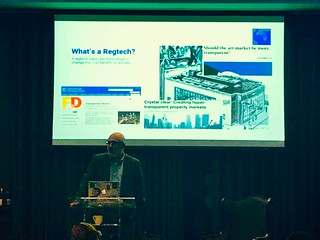
In “Radical Technologies”, Adam Greenfield wrote of the advance of automation that many of us (me included, by the way) cling to the hope that “there are some creative tasks that computers will simply never be able to peform”. I have no evidence that financial services regulation will be one of those tasks, so in my talk I suggested AI will be the most important “regtech” of all and made a few suggestions as to how regulators can plan to use the technology to create a better (that is faster, cheaper and more transparent) financial services sector.

AI as Regtech

Regulation, however, was only one the topics discussed in a fascinating couple of days of talks, discussions and case studies. The surprise for me was that there was a lot of discussion about ethics, and how to incorporate ethics into the decision-making processes of AI systems so that they can be audible and accountable. I hadn’t spent too much time thinking about this before, but I was certainly left with the impression that this might be one of the more difficult problems to address and talking with very well-informed experts. Although I must say that the most surprising discussion of the event that I was personally involved in took a very different tack: whether AIs employed in the service of financial institutions should come under the HR department or the IT department!

OK. So banks are going to be disrupted by AI. But where to start? I happened to be reading Call Credit’s interesting white paper “Credit, Fraud and Risk in the Age of Machines”. Their data scientists explore the use of machine learning in credit risk and fraud prevention. It’s that latter category that interests me most at the moment simply because fraud is so out of control, so I began to wonder whether this new technology is having any impact. Are Call Credit right to be optimistic about machine learning? The answer seems to be that they are, and that there may be light at the end of the tunnel. If we look at what AI is being deployed in the banking sector and what is it being used for, we see this optimistic reinforced.

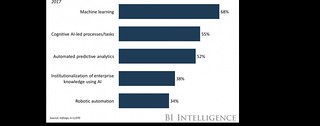
Let’s look in more detail. First of all, AI is an umbrella term so we need to be a little more specific. The most recent figures seem to indicate that the technology of machine learning is the main area of investment in banking. This is not surprising, because machine learning thrives when fed wast quantities of structured data. Banks have this in spades but have historically found it difficult to extract wisdom from it. 

Bank use of AI by technology//embedr.flickr.com/assets/client-code.js 

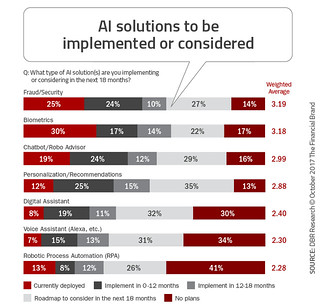
What are they using these machine learning systems for? Well, fraud does indeed seem to be the main business case with identification and authentication (including the use of biometrics) the highest priorities. Chatbots, robo-advisors and digital assistants are all fun, but in terms of making an impact on the bottom line, doing something about fraud beats everything else.

AI for what?//embedr.flickr.com/assets/client-code.js

Hence my optimistic interpretation. Identity is a mess, but we may be able to use AI to begin to mitigate some of the effects of this in the banking sector. Dave Webber, Director of Concept Management at Call Credit, sums it up nicely in their white paper by saying that “machine learning can help businesses make decisions by looking at data patterns… then looking for anomalies that indicate something isn’t right”. AI is good at this sort of pattern recognition and, I think, so much better at it than we are that it might even outsmart the fraudsters.

Arab driver filmed himself in his Porsche going 180mph | Daily Mail Online

xxx

Officers initially confiscated his passport before Ali changed his name by deed poll and applied for a new one, flying to Dubai two days before he was to be tried for possessing a quantity of bullets.

From Arab driver filmed himself in his Porsche going 180mph | Daily Mail Online

xxx

Australian police sting brings down paedophile forum on dark web | Society | The Guardian

snippet

To maintain their cover, undercover detectives were posting and sharing abuse material on Childs Play. Other users continued to post and view images while the site was under police control.

[From

Australian police sting brings down paedophile forum on dark web | Society | The Guardian

]

snippet

Chancellor announces £23bn Productivity Investment Fund – ITV News

xxx

Chancellor Philip Hammond has announced a new National Productivity Investment Fund of £23 billion to be spent on innovation and infrastructure over next five years.

From Chancellor announces £23bn Productivity Investment Fund – ITV News

Since this announcement productivity has collapsed still further.

Design a site like this with WordPress.com
Get started