Ex-Walmart exec says theft helped kill Walmart’s cashierless tech – Business Insider

xxx

A former Walmart executive said shopper theft was a major reason why the company killed Scan & Go, a cashierless-checkout technology, several months after expanding it to more than 100 stores.

From Ex-Walmart exec says theft helped kill Walmart’s cashierless tech – Business Insider.

xxx

The Era of General Purpose Computers is Ending

xxx

It’s not just a deteriorating Moore’s Law. The other driver toward specialized processors is a new set of applications that are not amenable to general-purpose computing. For starters, you have platforms like mobile devices and the internet of things (IoT) that are so demanding with regard to energy efficiency and cost, and are deployed in such large volumes, that they necessitated customized chips even with a relatively robust Moore’s Law in place.  Lower-volume applications with even more stringent requirements, such as in military and aviation hardware, are also conducive to special-purpose designs.  But the authors believe the real watershed moment for the industry is being enabled by deep learning, an application category that cuts across nearly every computing environment – mobile, desktop, embedded, cloud, and supercomputing.

Deep learning and its preferred hardware platform, GPUs, represent the most visible example of how computing may travel down the path from general-purpose to specialized processors.

From The Era of General Purpose Computers is Ending.

xxx

Voter ID is back, and this time it’s in Woking – 15Mb

xxx

“the main source of electoral fraud in the UK is not personation at the polling station but fraudulently-completed postal ballots, a situation that led one British judge to call it ‘a system that would disgrace a banana republic’.”

From “Voter ID is back, and this time it’s in Woking – 15Mb”.

xxx

Strict ID Laws Don’t Stop Voters: Evidence from a U.S. Nationwide Panel – Marginal REVOLUTION

xxx

“Using a difference-in-differences design on a 1.3-billion-observations panel, we find the laws have no negative effect on registration or turnout, overall or for any group defined by race, gender, age, or party affiliation. These results hold through a large number of specifications and cannot be attributed to mobilization against the laws, measured by campaign contributions and self-reported political engagement. ID requirements have no effect on fraud either – actual or perceived. Overall, our results suggest that efforts to reform voter ID laws may not have much impact on elections.”

From “Strict ID Laws Don’t Stop Voters: Evidence from a U.S. Nationwide Panel – Marginal REVOLUTION”.

xxx

FCA Crypto

In line with the Taskforce, we have categorised cryptoassets into three types of tokens;

  • Exchange tokens: these are not issued or backed by any central authority and are intended and designed to be used as a means of exchange. They are, usually, a decentralised tool for buying and selling goods and services without traditional intermediaries. These tokens are usually outside the perimeter. These are what I like of as “money-like” digital assets and I have expanded my discussion of these in the revised paperback edition of my book “Before Bablyon, Beyond Bitcoin” that will be published in a couple of months.

  • Security tokens: these are tokens with specific characteristics that mean they meet the definition of a Specified Investment like a share or a debt instrument (described in more detail in Chapter 3) as set out in the RAO, and are within the perimeter. Given the combined demands of investor protection and “system” protection, I think we are some way from seeing these in the mass market but the idea of properly-regulated “ICO” structures has a logic to it.

  • Utility tokens: these tokens grant holders access to a current or prospective product or service but do not grant holders rights that are the same as those granted by Specified Investments. Although utility tokens are not Specified Investments, they might meet the definition of e-money in certain circumstances (as could other tokens), in which case activities in relation to them may be within the perimeter. I can envisage private currencies (the “IBM Dollar”, for want of a better bumper sticker) that use this technology but I don’t see them becoming e-money because the e-money regulations as they stand effectively describe e-money as being issued against a 100% reserve rather than future delivery, if you see what I mean. I must ask someone more knowledgeable then I am about this distinction.

xxx

Preparing for Strong Customer Authentication and Open Banking (with or without Brexit) – Fieldfisher

xxx

“Due to the new ‘dynamic linking’ requirements for remote electronic payments, online retailers will no longer be able to charge an estimated amount to a customer’s card where the final amount is yet to be confirmed. Instead, the retailer will need to look at alternative mechanisms, such as obtaining authorisation for a maximum amount, but charging the final amount when it is known.”

From “Preparing for Strong Customer Authentication and Open Banking (with or without Brexit) – Fieldfisher”.

xxx

ECB chief says instant payments could break Visa/Mastercard duopoly

One of the European Central Bank (ECB) board members, Yves Mersch, recently said that “for merchants, instant payments at the POI (point of interaction) could be a cost-efficient alternative to cards”. This is hardly a new idea (I’ve written about it frequently) and I think that there is a general feeling in the cards business that credit transfers could take a third or so of the card volume in a post-PSD2 Europe. There are really three reasons for this:

  1. First of all, 

  2. Secondly,

  3. Finally I think that the reason why credit transfer will be big is that it won’t be only banks and merchants instructing these transfers. As I wrote for Wired magazine back in 2017, it will be the internet giants. As I said then, “Facebook will ask for (and get) direct access to your bank account and the payments infrastructure. Next time you need to send your friend a tenner, you’ll instant-message them the money, rather than opening up your boring bank app, fiddling about finding their bank details, authenticating yourself again and finally firing off the cash”.

XXXX

It’s time for a Bill of Data Rights – MIT Technology Review

xxx

“This essay argues that ‘data ownership’ is a flawed, counterproductive way of thinking about data. It not only does not fix existing problems; it creates new ones. Instead, we need a framework that gives people rights to stipulate how their data is used without requiring them to take ownership of it themselves.”

From “It’s time for a Bill of Data Rights – MIT Technology Review”.

xxx

Blog The shock of cash

A young relative of mine was coerced into spending this last week end at an English holiday camp resort. When she got there she was shocked to discover that, for whatever reason, they were cash only for the weekend! All over the complex were “cash only” signs! Remember, these signs are completely unfamiliar to anyone under the age of 30, especially from the South East of the country where Transport for London triggered the contactless revolution, because this a debit card generation in a country where more than half of card transactions are already contactless. Signs like this one would be invisible to her!
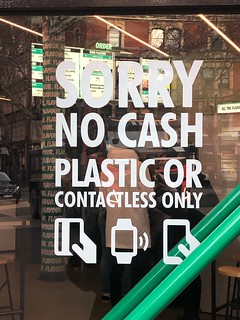
Cashless in London//embedr.flickr.com/assets/client-code.js

So here’s a normal young person, all of her money is in the bank and she never goes to ATMs, so imagine her further horror of having to use an ATM on site to get cash which then charged her £1.50 to get her own money. Even more punishing was the fact she had to go back to the ATM again for more cash so yet another £1.50 charge!!!
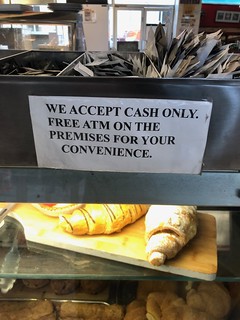
Cash Only in London//embedr.flickr.com/assets/client-code.js//embedr.flickr.com/assets/client-code.js

The question she asked over and over again during her stay was why in this day and age would such a large complex be cash only? Doesn’t anyone there have an iZettle or a PayPal account? That doesn’t seem like much of an investment when surely with so much cash around it could mean some staff creaming it off? A temptation surely. In this situation cash is expensive for the individual but it is also expensive for the organisation as a whole! Especially when you remember that cash has a lot of other hidden costs: armoured cars taking money to banks, the extra hour for workers to reconcile the till, robberies.

There’s no excuse for making people use cash in 2019. 


Design a site like this with WordPress.com
Get started