xxx
The number of over-65s embracing tap-and-go technology has soared, boosting card transactions to become Britain’s primary payment choice
From Cash is no longer king as pensioners buy into contactless revolution.
xxx
A library of snippets
xxx
The number of over-65s embracing tap-and-go technology has soared, boosting card transactions to become Britain’s primary payment choice
From Cash is no longer king as pensioners buy into contactless revolution.
xxx
xxx
Deutsche Bank has today announced a pilot project with the International Air Transport Association (IATA), the trade association for the world’s airlines, to test a disruptive new payment model. Through the pilot, Deutsche Bank will look to reduce costs for processing payments between airline clients and airlines. Deutsche Bank will collect customer payments directly from consumer accounts in line with the newly revised EU Payments Services Directive, PSD2. Currently, payments are mainly processed via credit and debit transactions.
From Deutsche Bank pilots game-changing payments solution with IATA – Newsroom.
xxx
xxx
“Social credit is preventing people from buying airline and train tickets, stopping social gatherings from happening, and blocking people from going on certain dating websites. Meanwhile, those viewed kindly are rewarded with discounted energy bills and similar perks.”
From “The odd reality of life under China’s all-seeing credit score system | WIRED UK”.
xxx
xxx
“The social credit schemes are presently a patchwork of public, private and public-private systems that use ongoing surveillance, state records, and snitch-lines to reward and punish Chinese people for behavior that the Chinese establishment frowns on, from indebtedness to beating up quack doctors to chasing pop stars through airports.”
xxx
xxx
In 1997 Pope John Paul II declared Isidore of Seville the patron saint of the internet.
From The patron saint of the internet is Isidore of Seville, who tried to record everything ever known.
xxx
xxx
A new regulatory model is needed, one that understands the complexities of data and balances privacy, security and competition across sectors. As we develop one, the playing field between lenders that have adapted to digital on the one hand and tech and fintech companies on the other will become more level.
From Fintech threatens to eclipse banks that do not adapt digitally.
xxx
xxx
A short editorial in the September 19, 1966 issue of the Sandusky Register newspaper in Sandusky, Ohio predicted that life was about to get worse as information, especially financial information, became more centralized.
The editorial noted that although the “com puter age” was “in its infancy,” the computerization of financial information would lead to more robbery, more embezzlement, and a complete “assault on personal privacy.” And we can’t say they were wrong.
From This 1966 Article About ‘Computer Danger’ Predicted a Bleak Future of Bank Crimes and Info Leaks.
xxx
Now, I’m not pointing to this article because it illustrates a unique genius for predicting the future, but because it doesn’t. Anyone who ever spent two minutes thinking about the world of online financial services must have thought the same. So with more than half a century to get ready for the world of virtual crime, why didn’t we do anything about it?
xxx
“The scope of the CMA’s retail banking order is narrower than the access requirements under PSD2, but it is envisaged that the Open Banking API will serve as a means of providing a standardised PSD2-compliant access interface. To this end, we note the proposed extension of the CMA9 specification for Open Banking APIs from personal and business accounts, to all the payment accounts covered by PSD2, i.e. credit cards, e-money wallets and some types of online savings accounts, as well as voluntary participation by other non-CMA9 ASPSPs.”
From “PSD2 | A revolutionary framework opening up UK payments | Osborne Clarke”.
When I took part in the judging of the NESTA Open Up Challenge, I noted that it was a common complaint from innovators developing new financial services that the open banking provisions did not cover credit cards (which is needed to establish credit references and history) and did not extend beyond the “CMA9” so this proposed extension is good news on two counts.
xxx
“She said she wanted people to have to disclose their real identity to providers like Facebook and Twitter. However, she said there were good reasons for whistleblowers to still appear anonymous to the public.”
From “MP Jess Phillips in web plea ‘after 600 rape threats’ – BBC News”.
This is a reframing of what I used to the call the “Clinton Paradox” after the former US Secretary of State. She gave a landmark speech about the internet to the UN (?) in which she said, essentially, that the internet should be available to everybody except for people that we don’t like. How can you have a system under which people have to provide their real identities and yet remain anonymous? Conversely, how can whistleblowers remain anonymous while non-whistleblowers do not? How do you know if I am going to be a whistleblower in the future or not?
Kevin Werbach published a very good article about tokens on the Knowledge @ Wharton site. He set out a useful taxonomy to help with discussion and debate around the topic, saying that
There is cryptocurrency: the idea that networks can securely transfer value without central points of control;
There is blockchain: the idea that networks can collectively reach consensus about information across trust boundaries;
And there are cryptoassets: the idea that virtual currencies can be “financialized” into tradable assets.
I might use a slightly different, more generalised approach (because a blockchain is only one kind of shared ledger that could be used to transfer digital values around), but Kevin summarises the situation exceedingly well. His perspective is that cryptocurrency is a revolutionary concept but the jury is still out on whether the revolution will succeed, whereas the shared ledger and the assets that might be managed using those shared ledgers are game-changing innovations but essentially evolutionary. The idea of such assets, which I will label digital bearer instruments, goes back to the long-ago days of DigiCash and Mondex, but the idea of implementing them using technology that is (in principle) available to every single person on the planet is wholly new.
This combination of the revolutionary but unproven and the evolutionary but nevertheless game changing fascinates me and I’ve been exploring it in a number of different areas. One such area is money, of course, and more particularly the notion of central bank digital currency. I feel this is often discussed in a confusing way. I see articles on the topic that almost randomly switch between “digital currency”, “cryptocurrency” and “digital fiat” to the point that they are essentially meaningless. So I thought it might be useful to build on my work and Kevin’s perspectives to create a worthwhile framework for exploring the topic.
Let’s begin by exploring what the central concept is all about. Ben Dyson and Jack Meaning from the Bank of England discuss a particular kind of central bank digital currency (what some would call “digital fiat”) with quite specific characteristics.
Universally accessible (anyone can hold it);
Interest-bearing (with a variable rate of interest);
Exchangeable for banknotes and central bank reserves at par (i.e. one-for-one);
Based on accounts linked to real-world identities (not anonymous tokens);
Withdrawable from your bank accounts (in the same way that you can withdraw banknotes).
This seems to me to be quite sensible definition to work with. So, digital fiat is a particular kind of digital money with these specific characteristics. We can now start to fill in the blanks about how such a system might work. For example, should it be centralised, distributed or decentralised? Given that, as The Economist noted in an article about given access to central bank money to everybody, “administrative costs should be low, given the no-frills nature of the accounts”, and given that a centralised system has the lowest cost, that would seem to point toward something like M-PESA but run by the government.
There are, however, other arguments in favour of using newer and more radical technological solutions., not least of which is our old friend privacy. Again, as The Economist notes, people might well be “uncomfortable with accounts that give governments detailed information about transactions, particularly if they hasten the decline of good old anonymous cash”. However, as I have often written, I think there are ways to deliver appropriate levels of privacy into this kind of transactional system and the pseudonymity is an obvious way to do this efficiently within a democratic framework.
Here’s my take on the situation, then, with a diagram that I’ve used for a while now. Note that it is congruent with Kevin’s taxonomy but adds the “digital identity” layer to show that the token trading might be pseudonymous in most practical circumstances within specified limits.
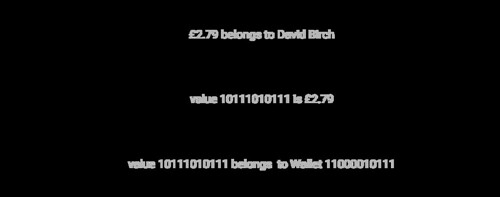
In this formulation, we have a digital value layer that may or may not be implemented using a cryptocurrency, then a cryptoasset layer built on top of that (let’s put one side what the different kinds of cryptoassets might be as for this discussion I’m only interested in digital money) and then a digital identity layer on top. My assumption is that cryptoassets will be implemented using what some people call “smart contracts” (I prefer the term “consensus applications”) and the general term for these assets has become “token”. So I hope you can now see how the world of Bitcoins and tokens and Initial Coin Offerings (ICOs) all comes together here.
Aside from privacy, there’s another argument for this kind of approach, and it has come to the fore in the light of the recent Visa Europe systems collapse, which is what to do to make such a digital money system, 99.999% available. Here is where new technologies might be able to deliver the step change that takes us into the realm of practical digital fiat. Such a payment system would be an element of critical national infrastructure, which is why it might be worth looking at some form of shared ledger technology, possibly even a blockchain of some kind, in this context.
So here’s a straw man to

 Snippings