Policy Exchange, which calls itself Britain’s leading think-tank, has published a report called “The Border Audit” (written by David Goodhart and Dr. Richard Norrie) which has a number of recommendations for post-Brexit Britain. They include the introduction of ESTAs for visitors, just as they have in the US, and some form of ID system. The report comments on the ID card system being developed for the 3.6m EU citizens expected to remain in the UK after March 2019 and suggests that this system become a trial run for an “initially voluntary system for UK citizens”. Since ID cards are the hallmark of the continental superstate that Breixt Britain hopes to avoid, it seems quite unlikely that the British government will go down such a path. The report might, however, stimulate the revisiting of a much better idea and a much better vision for the independent UK.
Commenting on the report for the BBC, David Goodhart said that “we strongly recommend reopening the debate about ID management to reassure people that we know who is in the country, for how long, and what their entitlements are”. It’s that last clause that I want to focus on, because here I think is the signpost to a route that provides, paradoxically, both increases security for the country and its citizens as well as practical privacy for all of us. It’s all about entitlements.
This is something.
As I have long maintained, Brexit or not, some future British (or perhaps English) government will certainly have to introduce something because of continuing concerns about illegal immigration, tax evasion, health tourism, benefit fraud and so forth. However, as David touches with his comment, the real solution is to our 21st-century identity crisis not an Indian-style Aadhar identity number or a Chinese social score, but a general-purpose National Entitlement Scheme (NES). Very few people reading either the Policy Exchange report or this blog will remember the long ago days before the last Labour government’s attempts to introduce a national identity card, but there was a time when there were consultations afoot around a much better idea, which was a national entitlement card. As my colleague Neil McEvoy and I pointed out in Consult Hyperion’s response to this consultation, the “card” is only one mechanism for storing and transporting entitlements and in the modern age there might be better ones, such as mobile phones for example, that can not only present credentials but, crucially, also validate them (a subject I will return to).
Suppose that the vision for national identity (based on the concepts of social graph, mobile authentication, pseudonyms and so on) focused on the entitlements rather than on either the transport mechanism or biographical details? Then, as a user of the scheme, I might have an entitlement to (for example) health care, Wetherspoons or access to the Wall Street Journal online. I might have these entitlements on my phone (so that’s the overwhelming majority of the population taken care of) or stored somewhere safe (eg, in my bank) or out on a blockchain somewhere. Remember, these entitlements would attest to my ability to do something: they would prove that I am entitled to do something (access the NHS, drink in the pub, read about Donald Trump), not who I am. They are about entitlement, not identity as a proxy for entitlement.
Therefore it must be done.
A decade ago I set out a vision for a 21st-century identity card. I tried to make it a vision that the public and the government and journalists and think tanks and everyone else could understand. It was a vision with genuine innovation and potential that subsequent technological developments have served only to sharpen. I tried to build a narrative founded in mass media because that’s where MPs and their Spads get their science and technology education from. This led me to suggest that in this matter, as in so many other things, Dr. Who should be the guide.
Just as Motorola famously created the flip phone around the Star Trek communicator, I built as vision of an identity service around Dr. Who’s psychic paper. As any devotee of the BBC’s wonderful series knows, the psychic paper shows the “inspector” whatever it is that they need to see. If the border guard is looking for a British passport, the psychic paper looks like a British passport. If the customs officer on Alpha Centuri wants to see a Betelguesian quarantine certificate, the psychic paper looks like a Betelguesian quarantine certificate.

Christopher Ecclestone flashes psychic paper.
I am completely serious using Dr. Who to frame the narrative. It may seem a little odd to base a major piece of national infrastructure on a children’s TV series, but as it turned out I was not the only person to look in this direction because the BBC fan form “Torchwood Think Tank” (no longer online) had the suggestion back in January 2007, noting “dialogue joke about wish fulfillment of Doctor Who’s Psychic I.D. card he flashes in Season 3, and how that’s the future of ID cards…”.
We all grew up with Dr. Who, so it engenders warm nostalgia. Now, obviously, there’s an age-related component to this. My favourite monsters were the cybermen and I always wanted to be Brigadier-General Lethbridge-Stewart, so that gives my age away, but my kids enjoyed just as much and I’m sure the current generation are looking forward to the new doctor just as much. Dr. Who is the perfect mechanism for explaining technology the public and to MPs and Ministers. However, “national entitlement scheme” sounds a bit 1950s so I’ve decided to re-label it: welcome to the Brexit Bona Fides scheme.
Brexit Bona Fides.
This is how the Brexit Bona Fides scheme works. Unlike Dr. Who’s psychic paper, this post-Brexit version of psychic paper only shows the viewer what he or she wants to see if the holder has the relevant credential. If you are trying to get into a nightclub, you need to prove to the bouncer that you are over 18. The bouncer is looking for a credential that proves you are over 18. You show your psychic paper to the bouncer and all it reveals to the bouncer is whether you are over 18 or not. That is all the bouncer is entitled to see, so that is all they can see: not your name, not your date of birth, not your inside leg measurement, not your address, not your employment status, sexual orientation or credit rating. All the bouncer sees is that you are old enough to drink. Provided you are over 18, of course. If you are not, the psychic paper remains blank, as shown below

You cannot forge this credential because it is digitally-signed by the issuer. If a 16-year old copies an 18-year old’s certificate into their psychic paper, it won’t work, because the incoming messages will be encrypted using the 18-year old’s public key, but the 16-year old lacks the corresponding private key (which can’t be copied because it’s never given up by the psychic paper — sorry, iPhone secure element). Since transmitting the photograph and appropriate credentials directly into the brain of the nightclub bouncer isn’t possible, we will of course need to use some kind of device instead. Luckily, just such a device already exists: the mobile phone.
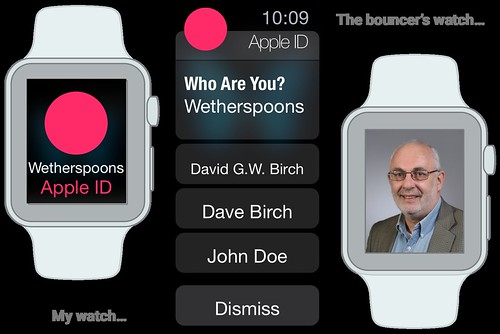
And, most important of all, my phone would be able to check the entitlements that it is allowed to when presented by your phone, so none of us would need special equipment. I show up with my phone and claim that I am entitled to vote: my phone presents a QR code that is read by the polling clerk’s phone which flashes up my picture if I am entitled to vote or a red cross if I am not. I walk up to Wetherspoons and the pub requests an IS_OVER_18 credential. My Apple Watch (or phone or whatever) presents a list of virtual identities that have such a credential digitally-signed by an authority acceptable to Wetherspoons (ie, one that they can sue if I’m under 18) and, assuming that I’ve chosen one that is valid, my picture pops up on the bouncer’s Apple Watch. If I don’t have such a credential, the bouncer sees a skulls and crossbones or something. The customer never sees any of the jiggery-pokery hiding their personally identifiable information (PII). In 99 out of 100 cases, displaying your photograph is the only authentication required: There’s no need for the supermarket to check your fingerprints, for the doctor to demand a PIN or for the pub to take a DNA sample.
This isn’t really magic, or even that complicated. It’s all done using standard contactless communications, standard cryptography, standard protocols, standard chips, cards, phones and photos. Incidentally, after writing many year ago about how we could implement a psychic ID card using the same contactless technology as is used in Oyster cards, I literally fell off my sofa after settling down to watch a Dr. Who Easter special only to see the BBC steal my idea! Yes, Dr. Who got on a London bus using his psychic ID card (see video here), clearly demonstrating that it has an ISO 14443 interface that can fool machinery as well as the psychic interface that can fool people.
Note also that using Brexit Bona Fides, no-one can read your psychic paper — no-one can check your Bona Fides* — unless they are allowed to and when they are allowed to, and all they can see is what they are allowed to see. No more showing the guy in the pub your name, date and place of birth and goodness knows what else just to prove you are 18. Under the hood, it’s all done using keys and certificates, credentials and local authentication: The nightclub bouncer has had to obtain a digital certificate that allows him to interrogate your ID card. His phone sends the certificate to your ID card. The ID card checks it, sees that it is asking for a proof of age. It sends back your photograph, digitally-signed (that’s how his phone knows it’s a real ID card, because it can check this signature). If you’re not old enough to drink, it sends back a digitally-signed red cross (or whatever).
Bona Fides will show the GP your health service number but only if you have the right to NHS healthcare, otherwise it will be blank. Bona Fides will show the employer your national insurance number (but only if you have the right to work in the U.K.). Bona Fides will show the pub absolutely nothing except your photograph (but only if you are old enough to drink). So this is a user-friendly way to implement all of the privacy-enhancing technologies that we would like to see incorporated in a modern national identity card scheme: sector-specific identifiers, pseudonyms, mutual authentication.
This is a way to deliver an identity card scheme that provides both more security and more privacy. It does not need a big database with everyone’s details and it does not need expensive, custom-built, specialist equipment. I argued in favour of this approach during the government’s first consultation on what was then known as the Entitlement Card, to no avail. Back in 2005, I wrote a piece for Prospect magazine (when, as it happens, David Goodhart was the editor) arguing that the government’s vision for the proposed ID card scheme was tragically out of date and backward-looking. Even the pressure group No2ID were nice about it, saying that that I was someone in favour on ID scheme who actually knows what I am talking but “unfortunately his preferred scheme is incompatible with the Government’s plans”. Indeed it was, but that didn’t matter because the scheme was scrapped by the next government anyway.
Writing about this kind of entitlement scheme four years ago, I thought that a national plan to finally do something useful about identity might obtain “parasitic vitality” (to use one of my favourite ID phrases) from the specific issue of voter ID. Maybe electronic voting could have been a focus to get the gov.verify scheme a flagship and get the public and private sector working together to deliver an infrastructure that will be of benefit to all. None of this ever happened, of course, but David Goodhart’s report has set me thinking that Brexit might finally provide the stimulus needed to develop the world’s fist 21st century identity scheme. Not digitised identity, but real digital identity.
* Bona Fides, for those of you who went to state schools as I did, is a Latin phrase meaning “good faith”. My dictionary definition includes:
informal: documentary evidence showing that a person is what they claim to be; credentials.
plural noun: bona fides; plural noun: bonafides
“he set about checking Loretta’s bona fides”
I’ll go and register the domain now.

 Snippings