Losses from Online Payment Fraud to More than Double by 2023

xxx

A new study from Juniper Research has found that annual online payment fraud losses from eCommerce, airline ticketing, money transfer and banking services, will reach $48 billion by 2023; up from the $22 billion in losses projected for 2018.

From Losses from Online Payment Fraud to More than Double by 2023.

xxx

CHYP Back from Money2020 China

What an interesting experience the first Money2020 in China was. It was held in Hangzhou, the home of AliPay, and I was delighted to have been invited along to share some of our experiences in the payments and to learn first hand about the Chinese approach to the sector.
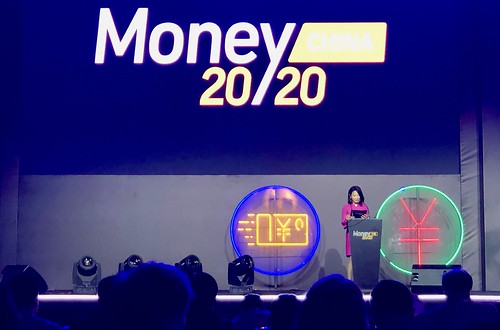
Money2020 China 18 - 7 of 28

Money2020 China gets underway

The event was well-staged and with simultaneous translation from Chinese it provided an opportunity to hear about the wide variety of fintech activities in China. It was, as you might imagine, very different from the Las Vegas event last month. There was no discussion of cryptocurrency because of the Chinese regulatory context and while I did see one presentation on the use of digital signatures in smart contracts, there was little discussion of blockchain and related technologies.
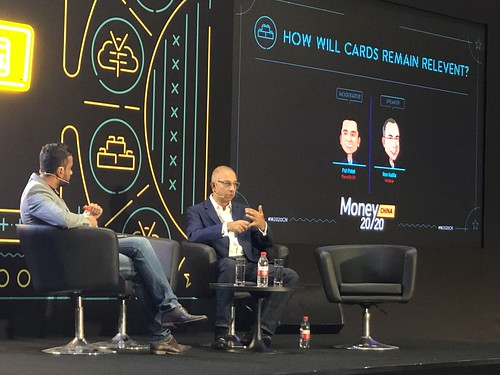
Money2020 China 18 - 14 of 28

Ron Kalifa talking about value-added merchant services

I particularly enjoyed Worldpay vice-chairman Ron Kalifa’s fireside chat (in which he said that people were underestimating the impact of open banking) and presentation of their annual world payments report. To a payments nerd like me this was a great opportunity to look at key trends in payments on a country-by-country basis and try to work out which trends are relevant to our clients around the world as they formulate strategies for the always-on, mobile-centric, open-banking future. Key to these strategies is, of course, security and so I always pay attention to the big picture presentations around fraud. In China, these have scary numbers attached to them, but you have to take into account the size of the Chinese economy (I think the Chinese cybercrime losses are lower than in many other countries).
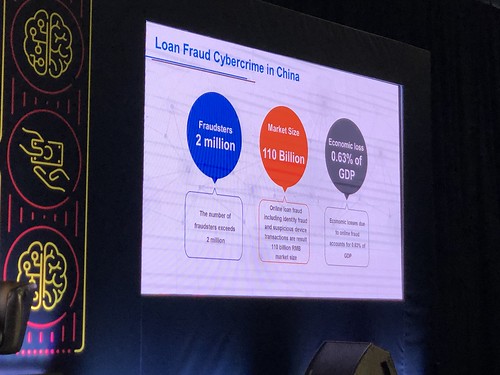
Money2020 China 18 - 26 of 28

Real, and scary, fraud numbers

Given the widespread use of scores of one form or another to determine trustworthiness it is no coincidence that China sees a rise in frauds relating to the manipulation of these scores. Without commenting on the benefits or otherwise of such models (most Brits, myself included, can only think of Black Mirror when social scores are discussed) it is worth making the point that preventing “gaming” of these scores while preserving individual privacy means dealing with paradoxes that might well be resolved through the use of cryptographic techniques that have no conventional analogues and are therefore difficult for policymakers to bear in mind.
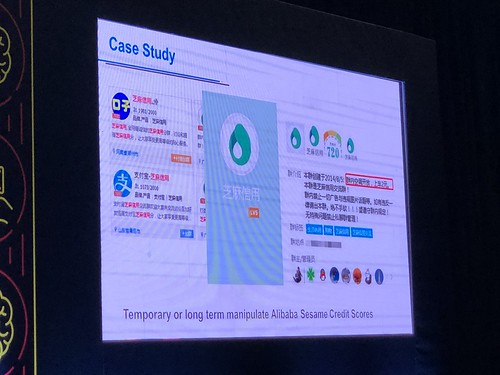
Money2020 China 18 - 27 of 28

Reputation fraud in action

Most of what I found thought-provoking, both in the presentations and the water cooler discussions, was to do with business models rather than new technologies. The new business models emerging in a regulated, platform-centric, dynamic market are what we should be studying. We might choose to implement some of these models in a slightly different way taking into account the varying cultural norms around security and privacy, but the idea of separating payments from banking and then turning payments into platforms, and then using these platforms to acquire customers at scale for other businesses is certainly very interesting.

These new models, of course, centre on data and value-adding using that data. When people pay for everything with their mobile phone, they lay down a seam of data that is waiting to be mined. Despite this, the convenience of the mobile-centre platforms is so great that people are clearly willing to put privacy concerns to one side. I chaired a great session on privacy with CashShield, Symphony and eCreditPal with, I think, gave out a very comforting message: if you build services with privacy in the first place, then actually complying with GDPR and other global regulations is actually not that much of a problem.

Money2020 China 18 - 25 of 28  

One more thing that struck me about the context for these developments that it seems to me that China is making its e-money regulation more like the EU’s. With an EU electronic money licence, the organisations holding the funds must keep them in Tier 1 capital and are not allowed to gamble the customer’s money, whereas in China there was no such restriction. Now the People’s Bank has said that from January 2019 the Chinese operators will have to hold a 100% reserve in non-interest bearing deposits at a commercial banks, a decision that will likely cost the main players (Tencent and Alipay) a billion dollars or so in revenue.

It was interesting spend a few days inside the mobile-centric, QR-everywhere, always-on, app and pay world of the future and picking up some useful lessons for our clients. A very interesting week.
POST Down under update

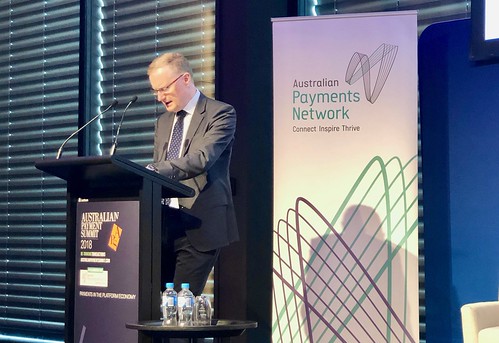
I had the good fortune to attend the Australian Payment Summit 2018 in Sydney this year, chairing the panel on Digital Currency and giving the first day closing keynote on the impact of artificial intelligence in the transaction space (I was developing the “where are the customers’ bots” theme). 

Naturally, one of the areas that I wanted to find out about was digital identity. As in many other countries, Australia is trying to deal with a complex mixture of requirements, goals and constraints for some form of digital identity infrastructure and it is far from clear what is going to happen. In the lead up to the event, the CTO of Westpac was quoted saying that “if you are going to move to a more open data-connected world, which we clearly are… you have to solve the problem of digital identity”. Well, yes. I agree 100%.

But how?

There is scepticism about a government solution. The Department of Home Affairs is looking at a single national digital identifier, which I am not sure is the right way forward since identity, as far as I am concerned, should be a menu. A recent report from Australian Strategic Policy Institute (a think tank) cautioned that an attempt to create some sort of digital identity could end up as “a repeat of the failed attempt to roll out the Australia Card” unless the government builds in privacy which, naturally, I agree with. So perhaps it is better to look to the private sector.

With a private sector solution, my preferred first step, of course, is to have regulated financial institutions do it. In Australia,this is indeed what is happening. Their approach is to have the Australian Payment Network (AusPayNet) tackle the problem under the auspices of the Australian Payments Council and they have been doing an interesting experiment in “agile” development to begin to explore what might be practical in the mass market, but it is still not clear how the banks will work together to deliver a mass-market solution that will be the platform that a modern economy needs. And, it turns out, I am not the only one.

Philip Lowe//embedr.flickr.com/assets/client-code.js 

In his keynote speech at the Summit the Governor of the Reserve Bank of Australia (RBA), Philip Lowe, said that digital identity is likely to become increasingly important as more and more activity takes place online and went on to say that the RBA is “highly supportive” of industry collaboration on this issue and views it as important that substantive progress is made. During the Q&A session he said (I paraphrase) “we all agree that something must done, but we can’t agree on what is it” and that the “institutions will need to compromise in the national interest”. I think these are very interesting (and very insightful) remarks.

This led me to 

A Journey Towards a Near Cashless Payments System | Speeches | RBA

xxx

new payment applications that provide a commercial return, not through charging for payment services, but by commercialising the value of the information that they obtain as a by-product of offering these services.

From A Journey Towards a Near Cashless Payments System | Speeches | RBA.

xxx

German eID card system vulnerable to online identity spoofing | ZDNet

xxx

Security researchers have found a vulnerability in the backbone of the electronic ID (eID) cards system used by the German state. The vulnerability, when exploited, allows an attacker to trick an online website and spoof the identity of another German citizen when using the eID authentication option.

From German eID card system vulnerable to online identity spoofing | ZDNet.

xxx

Government plans 5% rebates for some cashless payments after 2019 tax hike | The Japan Times

xxx

The government plans to give a 5 percent reward-point rebate to consumers on some payments made through credit cards and other cashless methods as a way of underpinning domestic demand after a planned tax increase next October,

From Government plans 5% rebates for some cashless payments after 2019 tax hike | The Japan Times.

xxx

Sweden’s Push to Get Rid of Cash Has Some Saying, ‘Not So Fast’ – The New York Times

xxx

There are two proposals by the Swedish authorities to keep cash at hand. Parliament wants just the biggest banks to handle cash. The central bank is holding out for all banks to keep money flowing. Swedbank, SEB and other big Swedish financial institutions are fighting the lawmakers’ demands, saying it would place an undue burden on them to provide greater access.

From Sweden’s Push to Get Rid of Cash Has Some Saying, ‘Not So Fast’ – The New York Times.

xxx

POST Cashless the IKEA way

There’s an interesting case study about this at IKEA in Gavle, which is about 100 miles north of Stockholm. According to the New York Times, managers there decided to go cashless temporarily last month after they realized that fewer than 1 percent of shoppers used cash. The economics of this decision are compelling. They found that employees were spending about 15 percent of their time handling, counting and storing money.

The usage statistics make for interesting reading. It turns out that to date only around 1 in every 1,000 customers wanted to pay with cash and that was mainly for low value transactions in the cafeteria (do they still call them “Swedish meatballs” over there?). For those few, IKEA has been giving them the food for free rather than mess around trying to bill them.

xxx

“Washington restaurateur Bo Blair, whose company Georgetown Events operates eight fast-casual and three sit-down restaurants in the District, decided to experiment going cashless when opening Surfside in Dupont Circle in 2015.

Usually, cost-conscious small businesses operate cash-only to avoid card processing fees.

But cash also has hidden costs, Blair said: Armored vehicles taking money to banks. An extra hour for workers to close out the register. Employees swiping money from the till. And some of his places had been robbed.”

From “Do cashless restaurants discriminate against the poor? D.C. lawmakers think so. – The Washington Post”.


xxx

Yes, that’s right. Cash is so much hassle that it’s cheaper to give out free meals rather than handle the stuff.

POST Safe in their hands

xxx

An aspiring Tory MP posed as the ‘youngest hereditary lord’ to slip into Parliament using a counterfeit security pass he bought online for £10.

From Aspiring Tory MP used fake pass he bought online to pose as ‘Lord Cramp’ and sneak into Parliament | Daily Mail Online.

xxx

xxx

But he was reported to security by a political assistant who recognised him from previous Conservative Party events.

From Aspiring Tory MP used fake pass he bought online to pose as ‘Lord Cramp’ and sneak into Parliament | Daily Mail Online.


xxx

Design a site like this with WordPress.com
Get started