xxx
xxx
xxx
A library of snippets
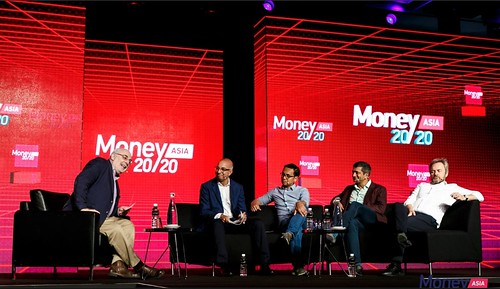
At Money20/20 Asia in Singapore this year, I had the privilege of charing the opening session on day two. The session was called “Wake Up with the CEOs” and the idea was to have a session where the audience could listen in on a discussion between people at the top of the industry, discussing the issues of the day. I have to say that from the feedback I got, it turned out to be a brilliant idea. Mind you, with a panel comprising Ron Kalifa (Vice Chairman of Worldpay), Aldi Haryopratomo (CEO of GO-PAY, here talking on CNBC), Rohan Mahadevan (SVP International Markets of PayPal) and Laurent Le Moal (CEO of PayU) it would have been difficult to make it boring.
There was no shortage of issues to discuss, one of them being that Worldpay (which The Economist called a “payments plumber”) is merging with FIS to create a $43 billion industry behemoth with the power to re-shape the sector (and with the announcement that they are enabling AmazonPay for their online merchants, they’ve already begun to do that) just a couple of months after Fiserv bought First Data in a $22 billion deal. And PayPal has just invested $750m in a Latin American processor, signalling more global ambitions. Meanwhile the scale of the Asian “wallets” continues to astonish (digital wallets will be a $25 billion business in Indonesia alone within five years). What a time to be in this business!
 //embedr.flickr.com/assets/client-code.js
One particularly interesting part of the conversation was about the relationship between payments and wallets. Obviously a wallet without payments is useless, but it’s not necessarily the payments that are the profitable part of the wallet. I might not go so far as to call them a Trojan horse, but they are a way to create a channel for higher added-value services. The way that Go-Jek created to the Go-Pay wallet to allow its drivers to get paid, and then the Go-Pay wallet gives access to other financial services is a model that is spreading [Nikkei Asian Review]. What’s more, these Asian players are now beginning to look to other markets (Last year, China’s Alipay paid some €200m to sponsor European football) and I’ve no doubt that their energy will benefit those markets.
xxx
xxx
xxx
Telecom players may opt for QR-based KYC method instead of Aadhaar
From Thanks But No Thanks, Telcos Say To Govt’s Aadhaar KYC Amendments.
xxx
Was it Andy Warhol who once said “if you try to pay with a $100 bill, they call the manager”? (Yes, ed.)
However, the touch screens include a button that allows customers to call a manager to accept cash payments, he said.
xxx
xxx
The Horn of Africa state has not issued official currency notes since 1991 and is banking on a $41 million donor-funded currency reform plan to phase out the counterfeit notes that account for more than 90 percent of the money in circulation in the country.
From Somalia seeks Nairobi expert in fake money purge – The East African.
xxx
One of the reasons why I love South by Southwest (or SXSW as we cool kids call it) is the serendipity. There’s so much going on at any one time that if you find your self in a talk that’s not that interesting or not that useful, you can just wander next door into something else. This was how come I found myself listening to a discussion about technology and populism with Samantha Dravis from Clout Public Affairs, Daniel Lippman from Politico, Robby Mook from the Belfer Center and Alex Slater from the Clyde Group.
The general thrust of the conversation
It’s my current fascination with authenticity and the link between digital identity and fake people, fake news and fake organisations that
For me, SXSW19 began with an interesting panel on the business models
Naturally, the conversation drifted toward policy and Elizabeth Warren’s recent remarks
While I agree wholly with the need to protect competition, and therefore capitalism, I do not think that breaking companies up is the way forward
Cindy Cohn said (correctly) that current anti-trust law is not suited to the demands of the digital age.
Hence I asked the panel about the alternative
Don’t break them up, open them up.
xxx
Babak, my nearest bicycle repairman, recently started taking Swish after tiring of having to find creative ways get around the 10,000 kronor weekly limit on depositing cash into machines.
From Sweden: how cash became more trouble than it’s worth | Money | The Guardian.
xxx
xxx
Analysis of accounts interconnected into a “Meghan Markle” Twitter community found around 1,000 “highly-connected” accounts which have tweeted more than two and half million times since September.
xxx

 Snippings