Implementing digital identity in the UK

The opening keynote at this year’s London Identity Week was given by Oliver Dowden, the Minister for Implementation at the Cabinet Office. Mr. Dowden is the Minister in charge of the digital transformation of government. To people like me, digital identity is central to digital transformation of government (and the digital transformation of everything else, for that matter) so I was looking forward to hearing the UK government’s vision for digital identity.  In his keynote, the Minister said that the UK is seen as being at the cutting edge of digital identity and that GOV.UK Verify is at the heart of that success. 

//embedr.flickr.com/assets/client-code.js

(On 9th October 2016, Mr. Dowden gave written statement HCWS978 to Parliament, announcing that the government was going to stop funding GOV.UK Verify after 18 months with the private sector responsible for funding after that.)

Right now you can’t use a GOV.UK Verify identity provider to log into your bank or any other private sector service provider. But in his speech the Minister said that he looks forward to a time when people can use a single login to “access their state pension and the savings account”. This, in my opinion, is quite distinct from the single identifier that the Parliamentary Select Committee on Science and Technology called for in their report this week. They said that

[Science and Tech Committee]

I have to say that I sort of agree with the Science and Technology Committee on the efficient delivery of public services as well as what the Minister said about a single login across both public and private services. Obviously you’d want the same login scheme but a different persona (an identifier plus credentials) for pensions, pornography and other purchases, but that’s a another issue and not the focus on this discussion.
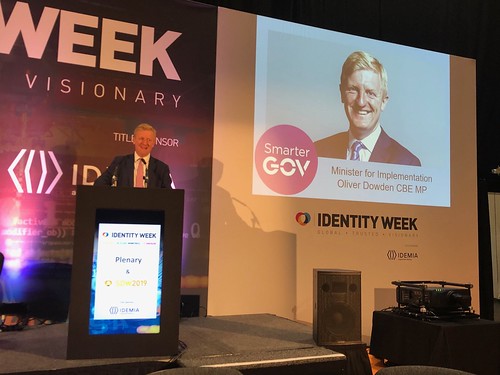
Identity Week Minister

//embedr.flickr.com/assets/client-code.js

Back to the Minister’s point though. Yes, it would be nice to have some sort of ID app on my phone (I happen to sit on the advisory board of Biid, who provide just such an app) and it would be great if my bank and Her Majesty’s Revenue and Customs (HMRC) and Woking Council and LinkedIn would all let me log in with this ID. The interesting question is who will provide such a login given that the government does not seem able to. Put a pin in that and we’ll return to it later. Meanwhile, back to the Minister, who made three substantive points in his speech. He talked about:

  • The creation of a new Digital Identity Unit, which is a collaboration between DCMS and Cabinet Office. The Unit will help foster co-operation between the public and private sector, ensure the adoption of interoperable standards, specification and schemes, and deliver on the outcome of the consultation.

  • A consultation to be issued in the coming weeks on how to deliver the effective organisation of the digital identity market. Through this consultation the government will work with industry, particularly with sectors who have frequent user identity interactions, to ensure interoperable ‘rules of the road’ for identity. To me, this sounds like a call for a trust framework of some kind but the Minister did not use those words.

  • The start of engagement on the commercial framework for consuming digital identities from the private sector for the period from April 2020 to ensure the continued delivery of public services. The Government Digital Service will continue to ensure alignment of commercial models that are adopted by the developing identity market to build a flourishing ecosystem that delivers value for everyone.

The Minister had a tight schedule was therefore unable to stay for my subsequent speech. I suggested that the idea of a general-purpose digital identity might be ambitious and a preferable strategy might be to look at who else could deliver the “digital identities from the private sector” used for the delivery of public services, which means delivering inclusive identity services with appropriate security at population scale. Perhaps DCMS has ensured that the UK taken a lead in this respect since, according to Sky News, “thanks to its ill-conceived porn block, the government has quietly blundered into the creation of a digital passport – then outsourced its development to private firms”. One of these firms runs the world’s largest pornography site, Pornhub, so I imagine they know a thing or two about population-scale identity management.

Identity Week Keynote

Assuming that the GOV.UK Verify identities fail to gain traction in the private sector, then I think there are two obvious private sector coalitions that might step in to do this for the government: the big banks and the big techs.

Big Banks

For a variety of reasons, I hope that the big banks are able to come together to  respond to the comments of Mark Carney, the Governor of the Bank of England, on the necessity for a digital identity in the finance sector to work with the banks to develop some sort of financial services passport. I made some practical suggestions about this earlier in the year and have continued to discuss the concept with potential stakeholders. I think it stacks up, but we’ll have to see how things develop. 

The reason why I’m so keen on this approach is that banks already do the hard work of establishing customer identities for know-your-customer (KYC) purposes but they don’t then do anything with it. So identity is a cost centre, when there is an opportunity for it to be a platform for new products and services. I’m not the only person who thought that the DCMS age verification legislation would be the trigger for a sophisticated federated privacy-enhancing bank-centric ID.

Modifications to open banking could allow bank customers to share data on their identity and their date of birth with third parties in a double-blind way that stops their bank from knowing the site they want to visit, or the site they’re visiting from knowing their identity.

From Don’t let the government’s porn block create a monopoly – 1828.

Well, whether it’s used for age verification or a pensions dashboard, I would have thought that what the European Commission Expert Group on Electronic Identification and Remote KYC Processes calls an “attribute-based LoA-rated KYC framework for the financial sector (ie, a financial services passport) would make a perfect post-Brexit stake-in-the-ground initiative to define the new era by boosting efficiency in the crucial Big Bank sector as well as providing a platform for new products and services for the Big Techs to develop. Talking of which…

Big Techs

I had the good fortune to attend more recent breakfast session with the Minister organised by the Cicero PR people. I have to say that the subject of digital identity came up more than once. There was considerable discussion (under the Chatham House rule) of both the priority of a UK digital identity infrastructure and the means by which it might come into existence. While I voiced my usual opinion that it should be the banks taking the lead, there were other people talking about alternative private sector providers.

It is clear, then, that if the banks can’t get it together then the big techs will  come knocking on the government’s door. I’ll readily admit that when the Minister said “private sector identities” in his speech, the first thought to flash across my brain was “Apple”. The public,  as well has civil servants in other departments who don’t really know or care about digital ID might be saying to themselves, “why can’t we just use ‘sign in with Apple’ to do our taxes?”, and this is a good point. Even if they are not saying it right now, they’ll be saying it soon as they get used to Apple’s mandate that all iOS apps that allow third-party sign-in must support it.

How would you use your Apple ID to log into HMRC? Easy: you log in as you do now after sending off for the password and waiting for it to come in the post and that sort of thing and then once you are connected tell them the Apple ID that you want to use in the future. If you want to be “jackdaniels@me.com” or whatever, it doesn’t matter. It’s just an identifier for the Revenue to recognise you. Then next time you go to log in to the Revenue, you log in as jackdaniels@me.com, something pops up on your iPhone and you put your thumb on it or look at it, and bingo you are logged in to fill out your PAYE without ever having to remember your taxpayer ID or government gateway passport ever again.


Incidentally, you could use this to log in at Pornhub too, because Apple have implemented a form of the persistent pseudonymity that I have long advocated as the core of a practical “privacy settlement”. So, as Wired magazine puts it, Apple’s universal login will let you hide your email address from third-party services. Unlike Facebook, Google and other services, Apple will randomly generate an email address on your behalf, and it then forward communications from the services that you sign up to on to your actual Apple ID address. I’m not joking about Apple delivering an infrastructure for the mass market instead of the government, it’s just that I thought that our forward-thinking innovation-centric banks would be the people to build on it. Here’s what a said about this a couple of year ago…

Why doesn’t my bank put a token in my Apple Pay that doesn’t disclose my name or any other personal information… Keep my real identity safe in the vault, give me blank card to top shopping with – a simple use case that will test the viability of the concept.

From Tired: Banks that store money. Wired: Banks that store identity | Consult Hyperion.

The banks have a chance to to do this if the government, the Bank of England and industry bodies get together and work with them on it. But I wouldn’t be at all surprised to go over to the HMRC web site fairly soon to see “log in with Amazon” and “log in with Apple” next a button with some incomprehensible waffle about eIDAS that I, and most other normal consumers I’m sure, will simply ignore.

Banks scramble to fix old systems as IT ‘cowboys’ ride into sunset – Reuters

xxx

“The Common Business-Oriented Language was developed nearly 60 years ago and has been gradually replaced by newer, more versatile languages such as Java, C and Python. Although few universities still offer COBOL courses, the language remains crucial to businesses and institutions around the world.

In the United States, the financial sector, major corporations and parts of the federal government still largely rely on it because it underpins powerful systems that were built in the 70s or 80s and never fully replaced. (GRAPHIC: tmsnrt.rs/2nMf18G)

And here lies the problem: if something goes wrong, few people know how to fix it.

The stakes are especially high for the financial industry, where an estimated $3 trillion in daily commerce flows through COBOL systems. The language underpins deposit accounts, check-clearing services, card networks, ATMs, mortgage servicing, loan ledgers and other services.”

From “Banks scramble to fix old systems as IT ‘cowboys’ ride into sunset – Reuters”.

xxx

POST Multigenerational Financial Services, Till Death Do Us Part (Not)

From the earliest days of the web, people have been wondering about what exactly death means in an online age. I have been reminded about this in the most unpleasant way recently, having lost a family member way to soon and having observed how the sadness and stress associated with such an event is multiplied and amplified because of modern life.

We are now in a situation where our data can cause endless complications for loved ones. Here’s an illustrative example: “I cursed my father every step of the way,” says Richard, a Canadian engineer who was executor of his father’s estate. Although his father had left behind a list of passwords, none of them were still valid and Richard could not access any of his father’s online accounts, his email or even log on to his home computer.

Post-functional money and VAT

I genuinely did not know this, having never been to either of the noted lap-dancing clubs Secrets or Platinum Lace, but such establishments require customers to buy vouchers, a private currency, to pay the dancers. The dancers do not, as you might expect in the modern world, accept credit cards (even contactless fnar fnar).

The customers are charged an entirely reasonable commission on the exchange of fiat currencies for the private currency. Presumably there are safety and security issues that drive the use of the private currency but I do remember reading about problems that occur in transactions of a similar context where the recipient, generally a marginalised woman, is presented with a collapsing currency (eg, Sterling) and cannot be sure of the value and therefore whether to accept the cash of note. I imagine the vouchers are seen as a sort of “stablecoin”, since the dancers can be sure of their value, whatever mechanisms or currencies are used to buy them.

Anyway, for whatever reason, there is a private currency is circulation. As a result, the clubs are in a dispute with HM Revenue & Customs over whether they should pay VAT on the commission they charge for exchanging customers’ cash for vouchers to pay dancers. The clubs believe this commission, about 20%, is a financial transaction and so should be exempt from VAT. HMRC thinks differently.

(Wait, what? 20%? Are they using my agent?)

This story is an interesting example of the use of what you might call “company money”. It’s akin to the use of chips in casinos or Disney Dollars. You change fiat currency that is good anywhere into a form of electronic money that is useful in only one area, but in the case it’s not useful because it is money. The function it performs 

Google Online Security Blog: New research: How effective is basic account hygiene at preventing hijacking

xxx

We found that an SMS code sent to a recovery phone number helped block 100% of automated bots, 96% of bulk phishing attacks, and 76% of targeted attacks. On-device prompts, a more secure replacement for SMS, helped prevent 100% of automated bots, 99% of bulk phishing attacks and 90% of targeted attacks.

From Google Online Security Blog: New research: How effective is basic account hygiene at preventing hijacking.

xxx

PQC

National Institute for Standards  and Technology (NIST) 8105 Report on Post-Quantum Cryptography (April 2016) frames the situation nicely, noting that in recent years there has been a substantial amount of research on quantum computers – machines that exploit quantum mechanical phenomena to solve mathematical problems that are difficult or intractable for conventional computers. If large-scale quantum computers are ever built, they will be able to break many of the public-key cryptosystems currently in use. This would seriously compromise the confidentiality and integrity of digital communications on the Internet and elsewhere. The UK National Cyber Security Centre concurs that the security of current approaches to asymmetric cryptography, as deployed in real-world systems that usually rely on either the difficulty of factoring integers (RSA) or calculating discrete logarithms (Diffie-Hellman, Elliptic Curve) is compromised in the presence of quantum computers.

Today, there are two known algorithms that quantum computers can use for cryptanalysis: Shor’s algorithm and Grover’s algorithm.

Shor’s algorithm first. The ability to quickly factor large numbers would break both RSA and discrete log-based cryptography. The fastest algorithm for integer factorization is the general number field sieve, which runs in sub-exponential time. However, in 1994 Peter Shor developed a quantum computer algorithm for integer factorisation that runs in polynomial time, and therefore would be able to break any RSA or discrete log-based crypto-system (including those using elliptic curves). This implies that all widely used public key cryptography would be insecure if someone were to build a quantum computer.

The other algorithm is Grover’s, which is able to invert functions in O(√n) time. This algorithm would reduce the security of symmetric key cryptography by a root factor, so AES-256 would only offer 128-bits of security. Since increasing the security of a hash function or AES by a factor of two is not very burdensome, Grover’s algorithm does not pose a serious threat to symmetric cryptography. Furthermore, none of the pseudorandom number generators suggested for cryptographic use would be affected by the invention of a quantum computer, other than perhaps the O(√n) factor incurred by Grover’s algorithm.

So, symmetric cryptography, and also forms of asymmetric cryptography built entirely from symmetric primitives, such as hash-based signatures, are not regarded as being vulnerable to quantum computation, as the best attacks are considered to be infeasible provided one uses large enough key (and block) sizes. In particular, when used with 256-bit keys, the AES block-cipher is currently considered to be safe from attack by any future conventional or quantum computer.

Vulnerabilities

A summary of the current situation is shown in the table below, which lists the impact of quantum computer on different cryptographic algorithms and thus highlights where vulnerabilities are.

Cryptography Use Case Example in Common Use Impact of Quantum Computer
Hashing SHA2, SHA3 None
Symmetric AES Longer key sizes needed
Asymmetric Factoring (RSA) Devastating
Asymmetric Discrete Log (DH) Devastating

To attack asymmetric cryptography, the bad guys need to perform an active attack (which would require access to a quantum computer) to forge a signature, but may passively collect data now and then break key agreements in the future once a quantum computer becomes available. This is worth doing in order to obtain the session keys that are used to encrypt message contents (in, for example, PGP). So even if you can’t read messages now it is still worth collecting them to break them in the future. This means that transitioning current systems to use quantum-safe key agreement schemes should be considered as a higher priority than transitioning to quantum-safe digital signatures.

The timescales are obviously unknown, but bear in mind that even a small 30-qubit universal quantum computer could, theoretically, run at the equivalent of a classical computer operating at 10 teraflops (10 trillion flops, or 10¹²), according to David Deutsch, at the University of Oxford’s Centre for Quantum Computation. NIST’s current estimate is that the first cryptographically relevant quantum computer could be built by 2030 for a cost of about one billion US dollars.

Countermeasures

Broadly speaking, there are two very different approaches to protecting against the threat posed by quantum computation. One is quantum key distribution, or QKD, which exploits quantum properties of physical systems, and so requires specialised hardware. The other is post-quantum cryptography, or PQC, which, as with existing forms of asymmetric cryptography, exploits the intractability of certain mathematical problems, and so can be implemented in hardware or software.

The goal of PQC (also called quantum-resistant cryptography, QRC) is to develop cryptographic systems that are secure against both quantum and classical computers, and can interoperate with existing communications protocols and networks. Based on current understanding, the NCSC believe that for most real-world communications systems, and particularly for government systems, PQC will offer much more effective and efficient security mitigations than QKD.

NIST initiated a “traditional” multi-round process to solicit, evaluate, and standardise one or more PQC public-key algorithms. The Round 2 candidates were announced January 30, 2019. There are 17  candidate public-key encryption and key-establishment algorithms together with nine different digital signature algorithms.

These algorithms are, essentially, in three different “families” that rely on different sources of mathematical difficulty. Lattice cryptosystems are built using geometric structures known as lattices and are represented using matrices. Code-based systems use error-correcting codes, as have been used in information security for decades. Multivariate systems depend on the difficulty of solving a system of quadratic polynomial equations over a finite field. Early opinion sees lattices as the most actively studied and the most flexible. They are capable of key exchanges, digital signatures, and far more sophisticated constructions like fully homomorphic encryption which, while not widely used now, we might expect to see at the heart of future business infrastructure in response to the continuing cyberwar around us.

Therefore, it seems to me that if we are to take a first step in the space (eg, sponsoring an M.Sc, maybe at Royal Holloway, or perhaps even sponsoring a Ph.D again) then the area to focus on is quantum-safe key agreement schemes using lattices. Is it reasonable goal to  have someone build one of these to run on a quantum computer simulator that we could use in a real payment system in, say, three years?

POS Malware Found at 102 Checkers Restaurant Locations | Threatpost

xxx

“The security incident stemmed from cybercriminals breaching Checkers’ systems and installing malware on point of sale systems across more than 100 of its stores. The malware is designed to collect data stored on the magnetic stripe of payment cards, including cardholder name, payment card number, card verification code and expiration date… The incident impacted 102 stores Checkers across 20 states – which were all exposed at varying dates, including as early as December 2015 to as recently as April 2019”

From “POS Malware Found at 102 Checkers Restaurant Locations | Threatpost”.

xxx

More Citizens and Businesses Satisfied with Government Digital Services

xxx

“NDI is a digital credential for users to transact with Government and businesses using a single trusted digital identity. Industry can make use of the NDI to build new services and improve the security and user experience of existing services. By the third quarter of FY19, the Government will launch ‘SG-Verify’, a facility for businesses to perform secure identity verification and data transfer through QR scanning. This will provide businesses an alternative for visitor registration and access, customer acquisition at roadshows, or any other use cases that require identification;”

From “More Citizens and Businesses Satisfied with Government Digital Services”.

xxx

Design a site like this with WordPress.com
Get started