xxx
At a conference today, Carney warned that if any crypto asset does become widely adopted, it would become “instantly systemic” and have to be subject to strong regulation.
xxx
A library of snippets
xxx
At a conference today, Carney warned that if any crypto asset does become widely adopted, it would become “instantly systemic” and have to be subject to strong regulation.
xxx
xxx
“The report — the largest-scale study of malicious bots in the EOS ecosystem — also found 51 percent of unique accounts and 75 percent of total transactions were driven by non-human accounts. Bot activity threatens the integrity of the blockchain industry, as user activity, transaction volume, and daily volume are among the most frequently called-upon metrics for determining technological validity, and precisely what is being faked, said Victor Fang, CEO of AnChain.”
From “Study: 75% of EOS Dapp Transactions Are Now Made By Bots – CoinDesk”.
xxx
The opening keynote at Identity Week in London was given by Oliver Dowden, the Minister for implementation at the Cabinet office and therefore the person in charge of the digital transformation of government. To people like me, digital identity is central to digital transformation of government (and the digital transformation of everything else, for that matter) so I was looking forward to hearing the UK government’s vision for digital identity. I got there early, and accompanied the Minister on his visit to the IDEMIA stand where he was shown a range of attractive burgundy passports.

In his keynote, the Minister said that the UK is seen as being at the cutting edge of digital identity and that GOV.UK Verify is at the heart of that success.
(For foreign visitors, perhaps unfamiliar with this cutting edge position, a spirit of transparency require me to note that back on 9th October 2016, Mr. Dowden gave written statement HCWS978 to Parliament, announcing that ,the government was going to stop funding up Verify after 18 months with the private sector responsible for funding after that.)
Given that the government spends around £1.5 billion per annum on “identity, fraud, error, debt, how much identity costs to validate, and how much proprietary hardware and software bought”, it’s obviously important for them to set an effective strategy. Now, members of the public, who don’t really know or care about digital ID might be saying to themselves, “why can’t we just use ‘sign in with Apple’ to do our taxes?”, and this is a good point. Even if they are not saying it right now, they’ll be saying it soon as they get used to Apple’s mandate that all apps that allow third-party sign-in must support it.
Right now you can’t use a GOV.UK Verify Identity Provider to log into your bank or any other private sector service provider. But in his speech the Minister said that he looks forward to a time when people can use a single login to “access their state pension and the savings account” and I have to say I agree with him. Obviously you’d want a different single login for gambling and pornography, but that’s already taken care of as, according to Sky News, “thanks to its ill-conceived porn block, the government has quietly blundered into the creation of a digital passport – then outsourced its development to private firms, without setting clear limits on how it is to be used”. One of these firms runs the world’s largest pornography site, Pornhub, so I imagine they know a thing or two about population-scale identity management.
Back to the Minister’s point though. Yes, it would be nice to have some sort of ID app on my phone and it would be great if my bank and the HMRC and Woking Council and LinkedIn would all let me log in with this ID. The interesting question is how you get to this login. Put a PIN in that and we’ll come back to it later.
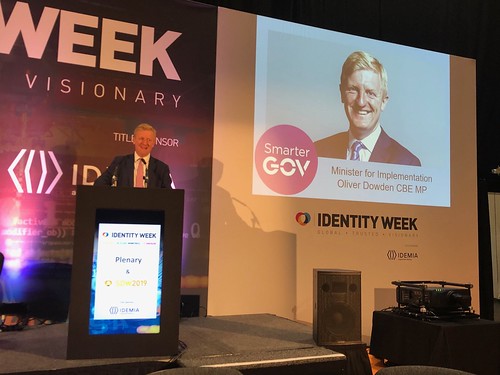
The Minister made three substantive points in the speech as far as I can tell from my notes. He talked about:
The creation of a new Digital Identity Unit, which is a collaboration between DCMS and Cabinet Office. The Unit will help foster co-operation between the public and private sector, ensure the adoption of interoperable standards, specification and schemes, and deliver on the outcome of the consultation.
A consultation to be issued in the coming weeks on how to deliver the effective organisation of the digital identity market. Through this consultation the government will work with industry, particularly with sectors who have frequent user identity interactions, to ensure interoperable ‘rules of the road’ for identity.
The start of engagement on the commercial framework for consuming digital identities from the private sector for the period from April 2020 to ensure the continued delivery of public services. The Government Digital Service will continue to ensure alignment of commercial models that are adopted by the developing identity market to build a flourishing ecosystem that delivers value for everyone.
The Minister was taken away on urgent business and therefore unable to stay for my speech, in which I suggested that the idea of a general-purpose digital identity might be quite a big bite to take at the problem. So therefore it would make sense to look at who else might provide the “digital identities from the private sector” used for the delivery of public services. Assuming that the current GOV.UK Verify identities fail to gain traction in the private sector, then I think there are two obvious private sector coalitions that might step in to do this for the government: the big banks and the big techs.
For a variety of reasons, I hope that the big banks are able to come together to respond to the comments of Mark Carney, the Governor of the Bank of England, on the necessity for a digital identity in the finance sector to work with the banks to develop some sort of financial services passport. I made some practical suggestions about this earlier in the year and have continued to discuss the concept with potential stakeholders. I think it stacks up, but we’ll have to see how things develop.

On the other hand, if the banks can’t get it together and the big techs come knocking, they are already showing off their solutions. I’ll readily admit that when the Minister first said “private sector identities”, the first thought to flash across my brain was “Apple”. But I wouldn’t be at all surprised to go over to the HMRC web site fairly soon to find a “log in with Amazon” and “sign in with Apple“ next a button with some incomprehensible waffle about eIDAS that I, and most other normal consumers I’m sure, will simply ignore.
How do you use Apple ID to log into the Inland Revenue? Easy: you log in as you do now after sending off the password and waiting for it to come in the post and that sort of thing and then once you are connected tell them the Apple ID that you want to use in the future. If you want to be “jackdaniels@me.com” or whatever, it doesn’t matter. It’s just an identifier for the Revenue to recognise you in the future. Then next time you go to the in the Revenue, you login as jackdaniels@me.com, something pops up on your iPhone and you put your thumb on it or look at it, and bingo you logged in to fill out your PAYE.
xxx
“Most existing digital identity solutions are either centralized (e.g., national identity cards) or individualistic (e.g., most ‘self-sovereign’ identity proposals). Outside of digital life, however, identity is typically social (for instance, ‘individual’ data such as birthdate is shared with parents) and intersectional (viz., different data and trust are shared with different others).”
xxx
xxx
“Another reason for caution over retail CBDC among central banks in advanced economies is the concern that commercial banks may suffer a loss in retail deposits to accounts at the central bank and, thus, lose a key funding source, potentially impacting credit provision.”
From “Motivations and prospects for central bank digital currency – Central Banking”.
xxx
xxx
“housands of taxi drivers in the Chinese city of Xi’an are now being verified by facial recognition technology when they get behind the wheel. And, true to the country’s security ethos, they’re also being monitored constantly by an AI system to ensure they aren’t engaging in prohibited activities such as smoking or using a smartphone while driving.”
From “Facial Recognition Verifies Taxi Drivers in China – Mobile ID World”.
xxx
xxx
“And in an even more dramatic measure, Apple’s universal login will let you hide your email address from third-party services. Unlike Facebook and Google, Apple will randomly generate an email address on your behalf, which then forwards communications from companies and institutions to your real address.”
From “‘Sign In With Apple’ Protects You in Ways Google and Facebook Don’t | WIRED”.
xxx
Madame Lagarde, the woman in charge of money, gave a speech in Japan recently in which she said that disruption in finance “is likely to come from the big tech firms, who will use their enormous customer bases and deep pockets to offer financial products based on big data and artificial intelligence”. But why will this be disruptive? After all, banks have big data and I don’t doubt that they could get hold of some intelligence from somewhere. So why is it disruptive?

 Snippings