Meta is looking at creating a metaverse token that will be, according to reports, more like its failed Facebook Credits virtual currency, which ran from 2001 to 2013, than its failed Libra digital currency that was terminated in 2022.
Introducing Polygon ID, Zero-Knowledge Identity for Web3 — Polygon | Blog
xxx
Polygon ID is private by default, offers on-chain verification and permissionless attestation.
From Introducing Polygon ID, Zero-Knowledge Identity for Web3 — Polygon | Blog:
xxx
POST Developing Digital Currency
xxx
Latest data from the World Bank in 2017 suggests that 73% of the population above the age of 16 use mobile money services—making Somalia one of the most dynamic markets in Africa and worldwide.
Despite only being introduced 10 years ago, over two thirds of all payments in Somalia now rely on mobile money platforms.
From Somalia changed the face of money transfers worldwide — Quartz Africa.
xxx
In comparison to neighboring markets like Kenya, which is home to Safaricom’s M-Pesa, one of Africa’s most well-known mobile money services, cash is transferred in dollars and most telecoms companies do not charge a fee for transfers.
Taxi for Cash
I have to say, I saw this coming. In near-cashless Somalia there was already the almost cashless enclave of Somaliland, the breakaway republic of 3.5m people that I wrote about a decade ago , when I said that “Somaliland might well become the world’s first cashless country. Not Iceland or the Netherlands, Korea or Kenya, but Somaliland”. This view was confirmed for me not because of futurologists or economists, but (as is true of the best theories, of course) because of a taxi driver.
Back in 2018, the Economic Club of Minnesota (ECOM) invited me to Minneapolis to give a talk on digital currencies. One of the points I made in the talk was the payments in the future are about my mobile phone talking to your mobile phone, not me handing something (banknotes, credit cards, cheques, whatever) to you. This means that the adoption of new forms of money can accelerate without updating or replacing cash registers or plastic cards. It is the mobile phone payment systems that are showing us what a cashless future might look like, not what was going on around Bitcoin.
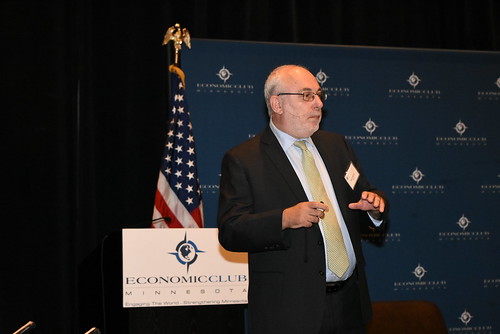
If you click on this picture, it will take you to a video of the talk and the Q&A session afterwards.
//embedr.flickr.com/assets/client-code.js
Anyway, the Club had arranged for a driver to pick me up from the airport and take me to the hotel. He was very interesting man of Somali origin and we had a nice chat in the car. He told me about his last visit to the old country, when he was surprised to find himself paying for everything (and he meant everything, from a nickel payment in the food market to a $400 remittance to relatives) using a mobile phone. Somali has a dynamic remittances sector with more than two million citizens living overseas and the the UN Development Programme that such remittances account for almost a third of the country’s GDP.
At the time of this taxi ride, a World Bank report had showed Somalia to be one of the most active mobile money markets in the world, outpacing most other countries in Africa. Mobile had superceded the use of cash (their words, not mine) in the country. Cash was not being banned, but it was approaching irrelevance. Apart form anything else, no-one used it because of widespread counterfeiting: As I said in my book “Before Babylon, Beyond Bitcoin“, a cashless country does not literally mean a country where cash is extinct. Some cash will linger for post-functional purposes, such as pinning to wedding dresses or waving around in casinos, but that cash will be irrelevant to GDP.
“It works on trust”, the taxi driver told me, “because there is no government”.
(I was thinking of telling him that in my opinion the reason it works at all is because there is no government, because in many countries where the government has done its best to regulate mobile payments mobile payments do not have anything like the penetration that they do in Somalia.)
Lessons
The world of mobile payments has fascinated me from its earliest days and I’ve been able to observe its evolution first hand. My colleagues at Consult Hyperion worked on the UK’s first prepaid scheme, first WAP “walled garden”, the first NFC trials and, as I explored in some detail recently to celebrate its 15th birthday, M-PESA in Kenya. Experience has given a pretty realistic picture of what is happening across the payments industry in general and mobile payments in particular, and my view is that we are heading toward a tipping point that will see us accelerating toward cashlessness.
Somalia is a place that we can learn from. It is not a template for the future of the digital Dollar or Britcoin, but it does have lessons for us that are important if we want digital currency to address the inclusion agenda. Like the UK, Somalia has no national identity infrastructure. Identity verification has to rely on other records, such as local government (eg, the electoral register in the UK). In order not to discourage financial inclusion for Somalis who do not have access to formal identification, unidentified users were allowed to hold wallets but with a low limit ($300).
How Amazon, Apple, Facebook, Google are infiltrating financial services | American Banker
xxx
Mega technology companies such as Amazon, Apple, Meta and Alphabet, the parent company of Google, occupy the tricky space of being both a friend and perceived threat to traditional financial institutions.
From How Amazon, Apple, Facebook, Google are infiltrating financial services | American Banker:
xxx
None of these companies have taken steps to obtain a banking license, so for now they need the support of financial institutions to offer bank products. But the prevalence of application programming interfaces and infrastructure providers means they don’t need to build financial capabilities in-house or take on the regulatory complexities,
Beyond the neoliberal-statist divide on the drivers of innovation: A political settlements reading of Kenya’s M-Pesa success story – ScienceDirect
xxx
Despite offering services that were cheaper than M-Pesa’s in almost all price bands, Airtel – the latest incarnation of Kenya’s struggling second MNO – failed to make a dent in the market because Safaricom “refused to open M-Pesa up”, locking users within its network.4
xxx
What Is Aave? Here’s Why Aave is One of the Leading DeFi Protocols | CoinCodex
xxx
Throughout its short existence Aave has been regularly introduced new features to its platform. One such powerful feature is called the “flash loan”. This feature takes advantage of the unique design properties of blockchains to offer non-collateralized loans that are instantly issued and settled.
On a blockchain, a transaction is only finalized when it is included into a bundle of information called a block and that block is recognized by the network as the official continuation of the blockchain. Each blockchain has its own characteristics and while it takes approximately 10 minutes for a new block to be mined on Bitcoin, that period is only around 13 seconds on Ethereum, the underlying blockchain of Aave protocol. Aave flash loans therefore happen in that 13-second time windows.
From What Is Aave? Here’s Why Aave is One of the Leading DeFi Protocols | CoinCodex:
xxx
A US Treasury official has warned crypto exchanges that help Russia skirt sanctions: ‘We will come, and we will find you’
Using crypto currency to bypass sanctions is not necessarily the best idea in the world because, as the US Treasury has made clear, the US will “track down and hold to account” anyone who helps Russia to avoid sanctions. In this they will be great aided by the much-trumpeted immutability of blockchains, which will serve to provide a permanent record of criminality to US law enforcement. Similarly, of course, those who donate cryptocurrency to Ukraine are providing a permanent record of their support to Mr. Putin and his agents.
Bitstamp boss urges ‘know-your-transaction’ crypto rules as Russia sanctions mount
xxx
Bitstamp’s chief executive Julian Sawyer is urging a culture of “compliance-first” as fears mount that crypto channels are being used to sidestep Russia sanctions.
From Bitstamp boss urges ‘know-your-transaction’ crypto rules as Russia sanctions mount:
xxx
Klarna launches open banking business unit
xxx
Klarna Kosma promises to provide financial institutions, fintechs and merchants with the connectivity to build FS apps and services by providing simple and secure access to 15,000 banks in 24 countries through a single API.
xxx
Klarna launches open banking business unit
xxx
Klarna Kosma promises to provide financial institutions, fintechs and merchants with the connectivity to build FS apps and services by providing simple and secure access to 15,000 banks in 24 countries through a single API.
xxx
 Snippings